



SHUEISHA Inc. All rights reserved.

The Venice Biennale, held every two years in the Italian city of Venice, has a history spanning more than 120 years. This year’s event brought together prominent figures in contemporary art from more than 40 countries.
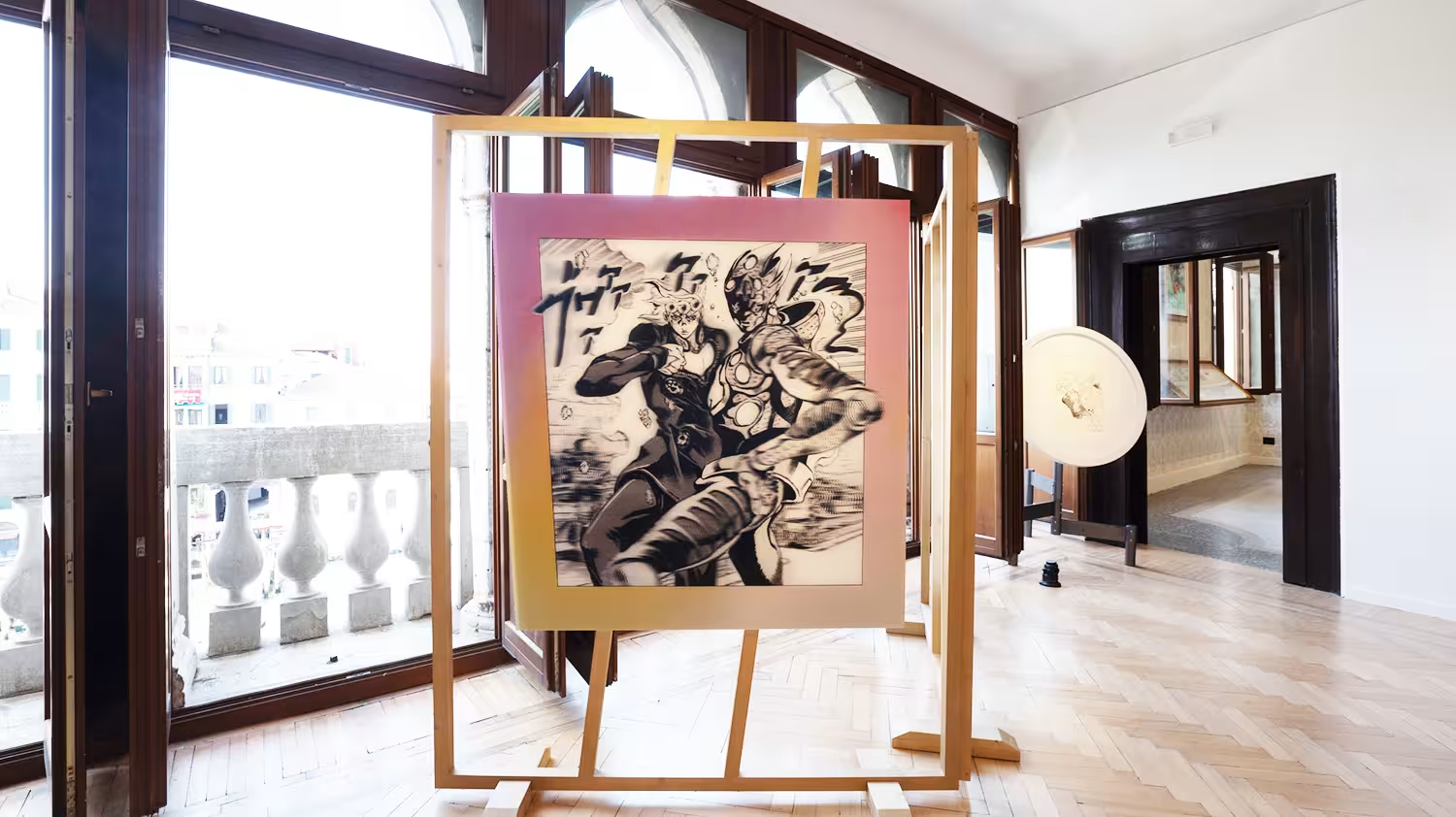
Personal Structures is one of the satellite events of the Biennale, a biennial contemporary art exhibition organised by the European Cultural Centre Italy. At this exhibition, B-OWND, a new platform for traditional Japanese crafts provided by Tanseisha—a company specializing in spatial design and creation, has teamed up with Shueisha Manga-Art Heritage (SMAH) for a collaborative presentation. B-OWND is showcasing six Japanese artists with roots in traditional crafts, along with an art collective that reinterprets the Japanese tea ceremony. SMAH is displaying works of manga art from Hirohiko Araki’s JoJo’s Bizarre Adventure. Held at the historic Palazzo Bembo in the city that also serves as the setting for Part 2 and Part 5 of the series, the exhibition has proven immensely popular.
In the previous installment, we sat down for a three-way discussion with Sara Danieli, a director at the ECC Italy, ; Ken Ishigami of B-OWND, responsible for planning and managing the exhibition; and Masashi Kinpachi Okamoto of SMAH, which participated in the exhibition through a manga art collaboration. In this installment, we take a deeper look at the exhibition through a conversation between Ken Ishigami and Masashi Okamoto, while also offering a look at a new collection of Hirohiko Araki’s manga art set to be released soon. Our conversation was held at the lounge space in Shueisha Manga-Art Heritage Tokyo Gallery.
Ken Ishigami(on the right)
Ken Ishigami is a producer at B-OWND. He explores new ways of presenting traditional crafts by planning exhibitions in Japan and abroad and collaborating with artists. Launched in 2019 as a new business of Tanseisha, B-OWND works with Startbahn’s art blockchain service, which also partners with SMAH, to promote traditional Japanese crafts as works of art in Japan and abroad.
https://www.b-ownd.com/
Displaying Art from JoJo in a Historic Building in Venice

Masashi Kinpachi Okamoto, Shueisha Manga-Art Heritage (SMAH below): As we discussed in our previous conversation with Sara Danieli of the ECC Italy, the exhibition has drawn a tremendous response in Venice. Visitors began lining up outside the palace more than an hour and a half before opening.
Ken Ishigami (Ishigami below): After the doors opened, the line still stretched around the palace, with more than 1,000 people waiting to enter. Even the ECC staff said that they’d never seen anything like it.
SMAH: There were people who waited for three hours, but there weren’t any major issues. I’m grateful for everyone who waited so patiently.
Ishigami: People seemed to have a lot of respect for the work and the artist. Some visitors viewed Hirohiko Araki’s works with a look of reverence, while others expressed their excitement with exuberant gestures of celebration. Even the staff, who were already well aware of JoJo’s immense appeal, were surprised by the overwhelming response.

Ishigami: I think the city of Venice itself was the perfect place to announce the collaborative project featuring JoJo and B-OWND.
Venice is actually the birthplace of the small, portable book format. Invented in Germany in the 15th century, letterpress printing became more widespread with the emergence of small, portable books. It is even said that nearly half of all new titles circulating in Europe between the late 15th and 16th centuries were published in Venice.
Travelers seeking to reach the far eastern reaches of the world, including Marco Polo, set out through Venice. It was a crossroads of Eastern and Western cultures, as well as a progressive city in terms of freedom of expression.
SMAH: Speaking of books, Pietro Bembo (1470–1547), who lived in the Palazzo Bembo, the venue for this exhibition, wrote the first comprehensive work of Italian grammatical theory during an era when Latin remained the primary written language among aristocrats and scholars, and Italian was considered merely a vernacular. It was a great honor to be able to display the works in the room where this man lived, where the Bembo family crest is carved on the floor.
That journey from being regarded as something “culturally inferior” to gaining recognition has something in common with manga. In the ‘60s and ‘70s, manga was heavily criticized, with people claiming that reading manga would make you dumb, or that manga was neither art nor culture. From the ‘80s onward, its reputation gradually changed, and manga came to be regarded as a source of cultural pride for Japan. When manga was translated and published overseas, people used to say that the format had to be changed from right-to-left to left-to-right or no one would read it. Over time, however, readers overseas came to accept the right-to-left format. It’s interesting that something similar was happening in Venice centuries ago — this dynamic of something that was once denied legitimacy turning into something mainstream.

SMAH: How did it feel to see the JoJo lithographs and lenticular works there in person?
Ishigami: What impressed me the most was the lenticular works. I was already familiar with the technique from stickers and cards, but the quality of these pieces was in a different league. Maybe it was due to the size, but there was this strange sensation that the images were actually leaping out at you. Visitors who had come for the manga, crafts, or art would stop at the lenticular works and stay for a long time, moving from side to side as they took them in. As you move, the way the image appears gradually changes. It struck me as a medium somewhere between animation and manga, and between three- and two-dimensional.
A Collection of Works Born Out of Exhibitions in Four Cities

SMAH: We’re actually working on an art print collection primarily featuring these JoJo lithographs, which will also include photos from the Personal Structures exhibition.
When we spoke to Mr. Araki about producing the collection, he asked me to make something that “wouldn’t get in the way.” We understood that to mean he doesn’t want it to be something so overdone that it will be hard to find space for, so we aimed to create a simple book that could be displayed like a single painting. There is no title or publisher on the front of the cover, only artwork and a signature.
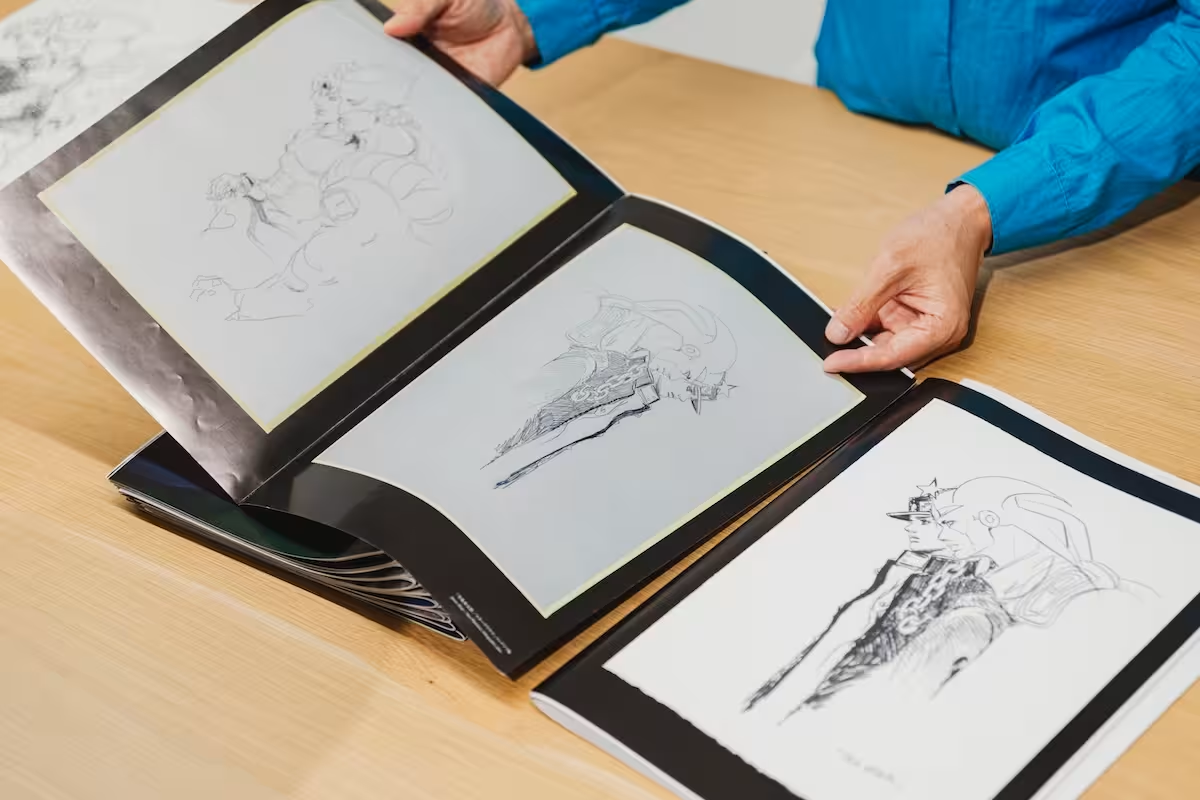
SMAH: For a weekly series, the artist needs to create a story of about 20 pages every week on his or her own. Araki moved to a monthly schedule in 2005, but he has now been working this way for almost 40 years. (The series was transferred to the monthly publication Ultra Jump during the serialization of Part 7, Steel Ball Run.) His work is fun to hold in your hand and read as manga, of course, but when you turn a single illustration into a printed work of art, a new appeal emerges. I think it has tremendous power.
Ishigami: When his work is displayed alongside a variety of craft works in the historic setting of Palazzo Bembo, it’s remarkably convincing.

SMAH: For this project, we photographed the process of Mr. Araki drawing directly onto the lithographic plate. In lithography, the images drawn on the plate appear horizontally reversed in the final print. Once you draw a line, you can’t erase it with an eraser or any other tool. And yet, Mr. Araki completes the illustration in one go, without using a mirror.
Mr. Araki is soft-spoken during interviews and photo shoots, and he welcomed us with a smile that day. But as soon as he sat down at the desk and said, “I’ll start drawing now,” his expression transformed completely. The entire room seemed to grow tense. The dermatograph swept vigorously across the plate, leaving lines in its path. I got goosebumps when I realized that he had been creating art with this level of intensity for decades.
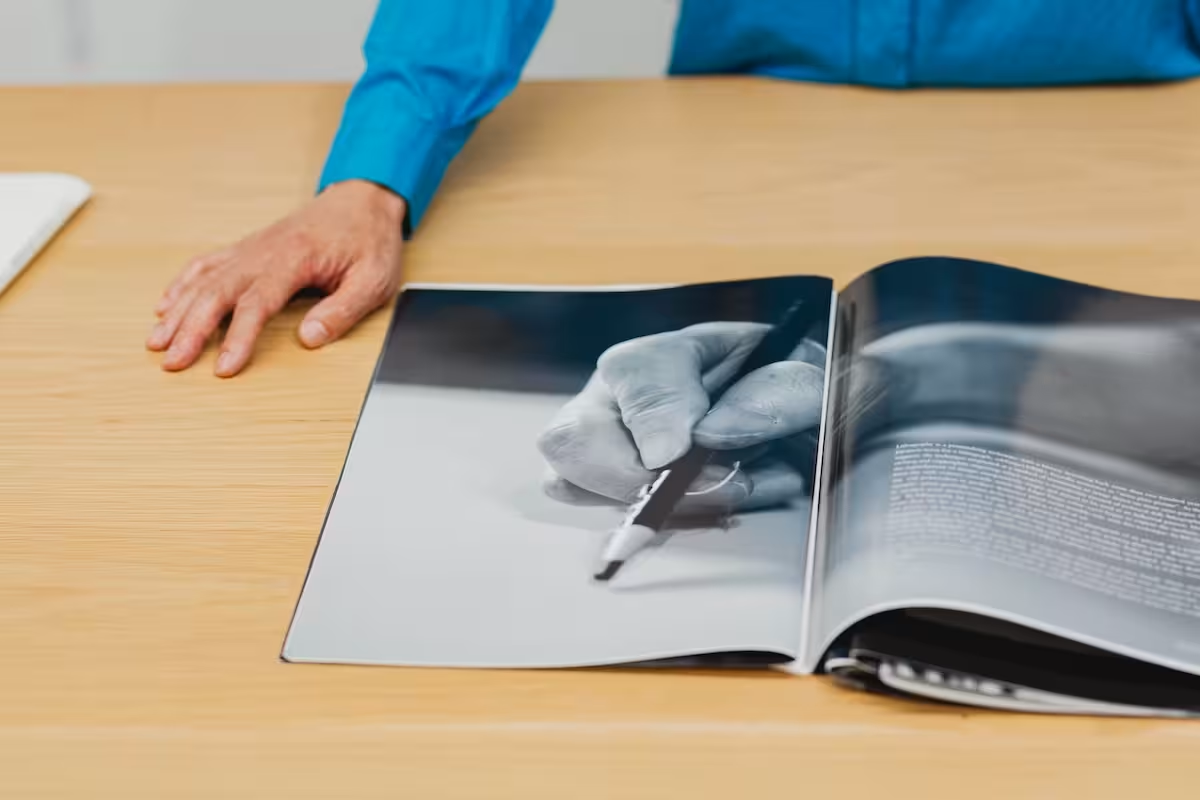
The manga’s black-and-white pages are created specifically for letterpress printing in magazine pages. During prepress, the artwork is turned into binary image data consisting of clearly defined black and white areas before being printed. As a result, gradations cannot be reproduced. With lithography, however, what the artist draws becomes the actual plate from which the image is printed. This means that the details, shading, and feel of the lines are preserved. There’s a different appeal to the lines than in the manga, and the way the characters and Stands come across as powerful, sharp, or sexy felt fresh and compelling.
Ishigami: The way you see the works will vary depending on the light in the venue, which changes with the time and weather, as well as your position and viewing angle. The photographs taken by Naoki Honjo also seem to capture the distinct light and atmosphere of the exhibition at each location.

SMAH: The collection of works that we are creating will be a unique book that is different from a catalog, an art book, or a photo book. This book was made possible by the current exhibition in Venice, which was itself the result of the journey through San Francisco, Kyoto, and Tokyo. We hope you’ll also enjoy the story of the exhibition itself as it traveled through four cities.
Text: Tomoko Yanagisawa Edited by: Kei Osawa Discussion Photos: Haruyuki Shirai

