



SHUEISHA Inc. All rights reserved.

Click here for Volume 1 → Discussing the Letterpress Vol.1
Yoshinori Kuroyanagi
Born in Nagano in 1947, Yoshinori Kuroyanagi joined Tsutatomo Printing Co., Ltd. in March 1963. He is a printer who finishes printed materials that require advanced technology with expert skill. He has been with the company for 59 years. His hobbies include drinking, smoking, and sometimes fishing.
Masao Takaoka
Born in Tokyo in 1957, Mr. Takaoka joined his father's company, the Kazui Press in 1982, and has served as Representative Director since 1995. He is a Fellow of the Royal Society of Arts (RSA), a Tokyo Meister (outstanding engineer) certified by the Tokyo Metropolitan Government, a "Master of Techniques" certified by the Shinjuku Monozukuri Meister, and an advisor to Monotype.
The challenges of solid color expression
Masashi Okamoto (SMAH), Shueisha Manga-Art Heritage: Shueisha Manga Art Heritage: Recently, I have had more opportunity to speak with people from various printing companies, and many of them who have been in the business for many years know about the process of wrapping paper around a copper cylinder, and they tell me it's very difficult. There's knowledge and skills you need to learn, such as how to use a cutter to cut to avoid printing pressure where you want to print faintly. Did your seniors teach you about these things?
Yoshinori Kuroyanagi of Tsutatomo Printing: Yes. In our case, we used a Heidel (a printing press made by Heidelberg in Germany), but in the old days, there was something called a photographic plate that was used to print black and white photo collections with a letterpress. A vendor told me that while offset printing might produce good results, there was a unique type of photo ink that produces a glossy finish, and that this type of ink would make photos come out even more beautifully. It dries very fast, so I used the same photographic ink with a letterpress to print those photographic plates.
Masao Takaoka of the Kazui Press: Yes, there was. Do you still have them?
Kuroyanagi: Not anymore.
Takaoka:That's what I thought.
SMAH: Does printing with a letterpress mean that the gradations in the photos are produced using fine dots?
Kuroyanagi: Yes, that is correct.
Takaoka: It makes it look like the mugshots of criminals you normally see in newspapers back then.
SMAH: It gives the photos a rather unique look.
Takaoka: Yes, it does. Offset printing uses less ink because the image is transferred to a blanket before it is printed on paper. Letterpress printing is said to produce richer and deeper results, because the amount of ink per square millimeter is on another level.
SMAH: Speaking of the amount of ink, Mr. Takaoka was surprised at how much ink you use. Is it really that different from normal printing?
Kuroyanagi: When you're printing solid fills, the amount of ink used is completely different.
Takaoka: A lot of ink is taken by the plate. More and more of it gets taken away, so it gets thinner and thinner.
Kuroyanagi: An example is when a photo of a person is printed with half-tones for the chest and face, while the person is wearing solid black. If you do it with an amount of ink suitable for the solid black part, the half-tones will also turn black. In that case, you have no choice but to wash the plate.
SMAH:The image from BLEACH you printed for this project must have been very difficult to produce. The character is wearing black, but the hair and other parts are very detailed, and you had to print both parts on the same page.
Kuroyanagi: Through trial and error, we figured out a process where we print the screentones using offset printing, and then printed over it with the letterpress. Offset printing produces beautiful results on that paper. You can't produce results like that with just a letterpress.
SMAH: For this project, you printed on thick paper made of 100% cotton. Is this your first time using this kind of paper?
Kuroyanagi: This was the first time for me to use that type of paper with a letterpress.
SMAH: Do you usually use thinner paper?
Kuroyanagi: Yes, that's right.
Takaoka: Unlike a platen (flat pressure type) press, a cylinder type press like this one rolls the paper inside, so if the paper is hard, it will flop. I shudder just to think about it. (Laughs).
SMAH: It makes a loud bang before the paper comes out. Is that the sound of paper flopping?
Kuroyanagi: Yes. It's the sound of the paper hitting metal.
SMAH: Does that noise occur when you're printing normally?
Kuroyanagi: Well, it is not as loud.
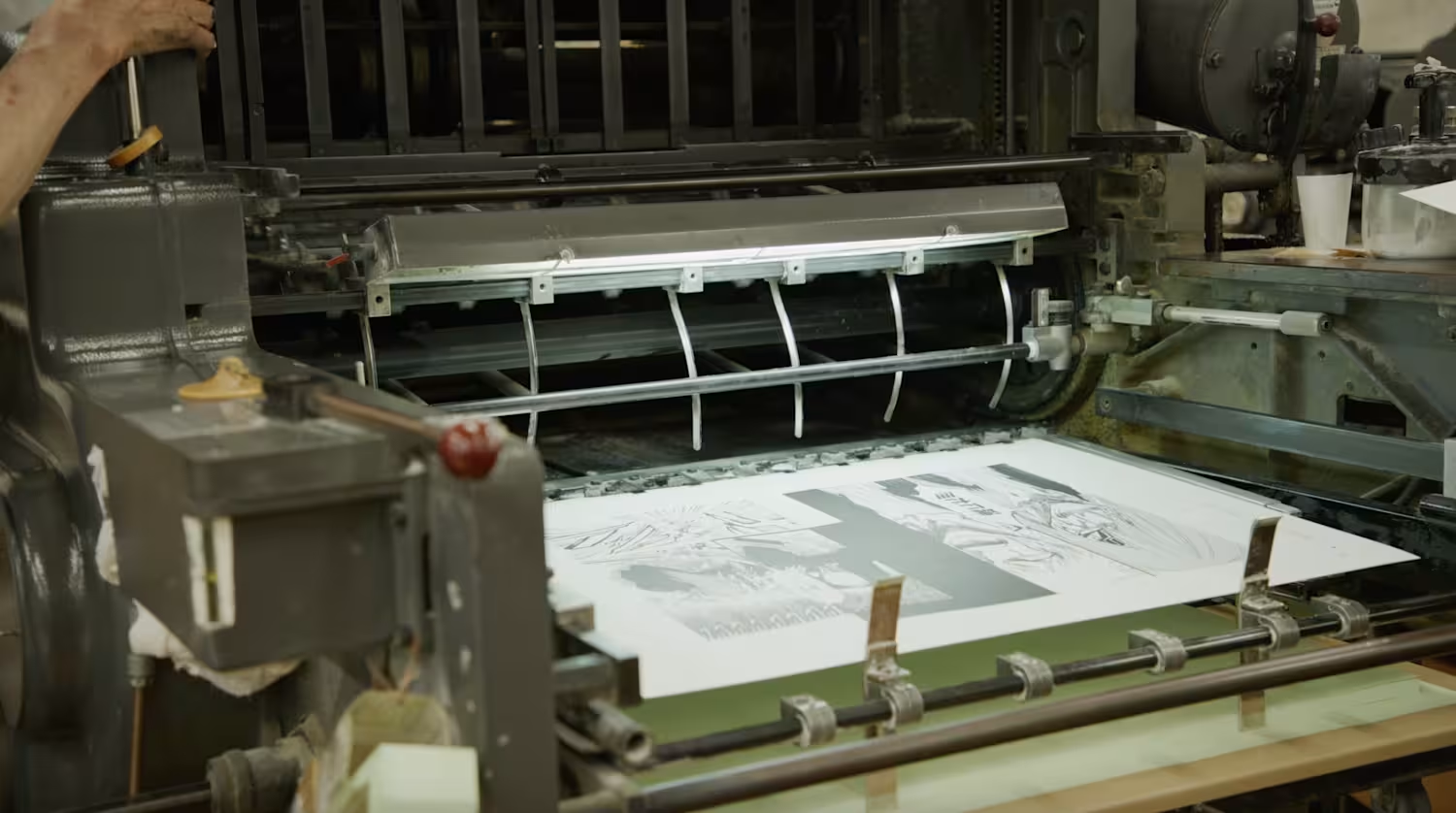
Takaoka: We used to have a hand-operated cylinder press, so I have some experience with them too. It would normally be impossible with this machine, but ours was a small machine, so when we used thick paper, we had to hold the cylinder by hand each time to prevent it from making that noise. If you don't hold it down and release it at the very last minute, thick paper will not work at all. With paper like this, you still have to hold it down tight, and that kind of thickness makes it very difficult. I think Mr. Kuroyanagi was just barely able to do it because of the size of Tsutatomo's printing press, but if the paper were any thicker, it might have been impossible.
A letterpress tool that is no longer available
SMAH: This time I learned that letterpresses can be used for more than just black and white printing, which is very interesting. You can perforate, print watercolor patterns, and so on. It is called a printing press, but it also has many other functions.
Kuroyanagi: That's right. They can be used for various purposes, such up a mold frame and die-cutting.
SMAH: I understand that they are rarely used for printing these days, but how have things changed since you started working with them?
Kuroyanagi: In our case, it was printed books or booklets called page-mono. They came out around 1983. We often used letterpresses to print photo albums. The Heidel presses have hard cylinders, so it prints easily. We wound two sheets of 135-kilogram fine-quality stock and two sheets of the same 135-kilogram coated stock, and because of the stiff body, we could increase the pressure to hold the paper between the sheets, which made for beautiful results.
Takaoka: Heidel's printing presses is made in Germany, and the metal used for the cylinders is hard. Machines made in Japan also use steel, but the composition of the metal itself is different, and is not as hard.
SMAH: Does this mean that the quality of the printing presses or the ease of operation is completely different? Come to think of it, Mr. Takaoka told me about how when a Heidelberg printing press was delivered to Kazui Press, he was impressed by everything, even the screws on the wooden crate that was sent from Germany.
Kuroyanagi: (Laughs)
Takaoka: We installed Heidel in 1963. The platen (Platen T-type printing press) was delivered in a wooden crate, and we disassembled the wooden frame in front of our workshop and put it inside. We removed the screws that held the crate in place and left them there to be picked up later by the shipping company. Then a strange old man came and asked my father (Shigezo Takaoka, the first president of Kazui Press) if he could have the screws. As far as we were concerned, they were not part of the machine, so we replied, "Oh, go ahead, but why? He replied, "We are actually a screw manufacturer, but we cannot make this type of screw in Japan. The composition of the metal is different, it is very hard, and difficult to process and quite firm. Germany can make them, but we are not able to with our current Japanese machines. He said, "Can I have it as a reference?" I think the level of Japanese industry at that time was obviously different from that of Germany.
SMAH: These were very expensive machines at the time. Mr. Kuroyanagi, when you started your work, the printing press must have been brand new. How did it feel to touch and operate it?
Kuroyanagi: If there was any white powder on the machine (to prevent sheets of paper from sticking to each other), we would immediately brush it off and polish it. Now that I'm used to it, I'm not going to go that far. (Laughs)
Even now, when we do a big cleaning once a year, we take out all the oil from inside the piston and spend an entire day cleaning everything inside the machine thoroughly.
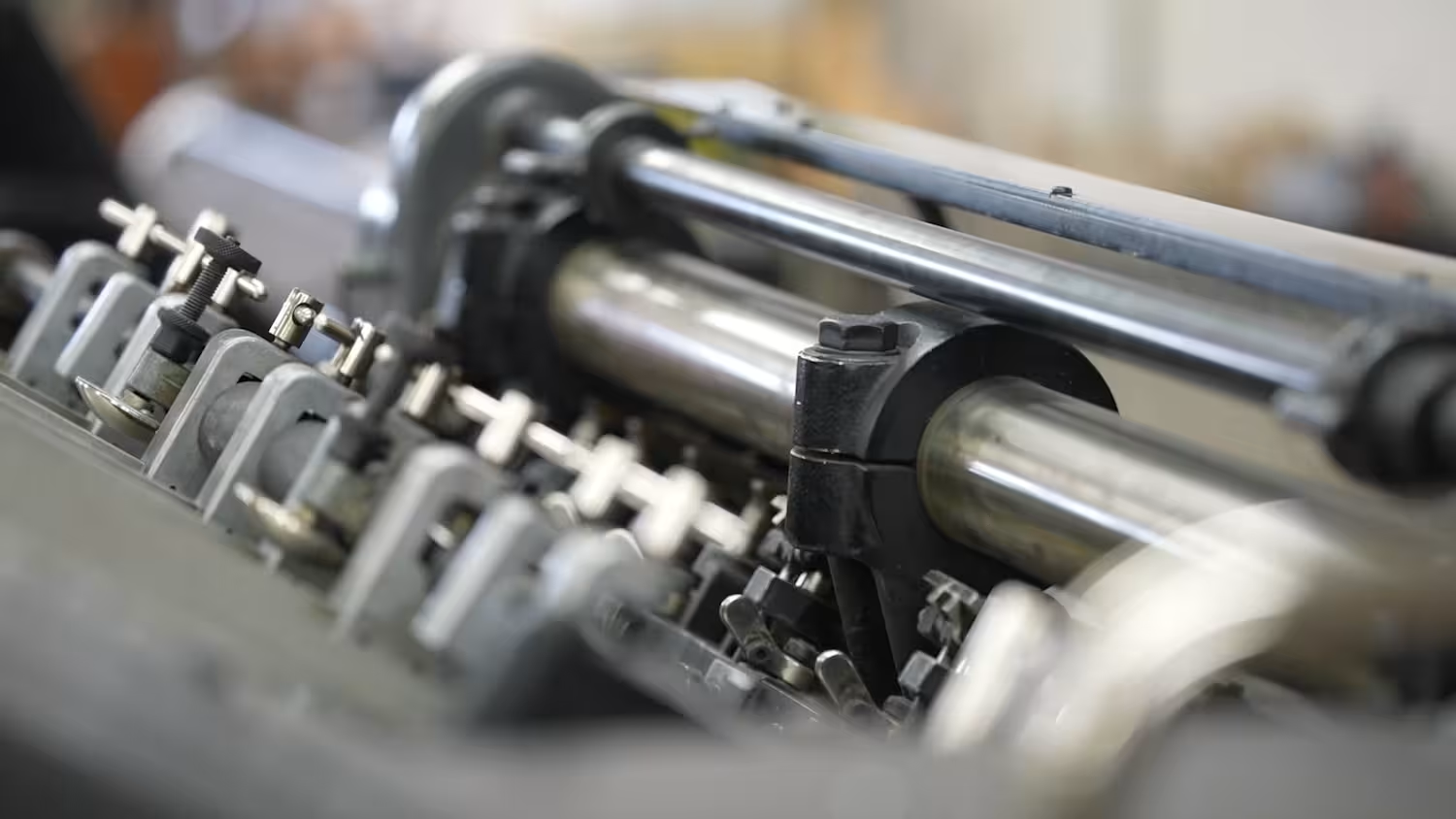
SMAH: As you wash them, do you feel what kind of parts are where?
Kuroyanagi: Yes. A long time ago, we had a machinist come over and teach us everything about the Heidel we use now, like how to take off all the covers and move the screws here by 1 millimeter to lower or raise the body, but I've forgotten all of that. (Laughs)
Everyone: (Laughs)
Kuroyanagi: If a little strain is applied during use, the cylinder pressure will be completely different. If you're asking yourself why the cylinder pressure is so low when printing on a sheet of paper, it might be loose.
SMAH: Do you mean one loose screw is causing the problem?
Kuroyanagi: That's right. But you have to take off all the covers to fix it. It's heavy, and we don't have the tools or equipment to do that. There's nothing we can do except make adjustments by adding an extra sheet of paper.
SMAH: Mr. Takaoka, you mentioned that there is no place in Japan that can produce spacers to adjust the position of the base for letterpress printing anymore.
Takaoka: You're referring to interline leads. It turns out they can't be made anymore, and we only have a few left in stock. We have no choice but to take care of what we have.
Kuroyanagi: Same here. We brought everything when we moved to this workshop. Those parts, in particular, are quite precious. We need to take good care of them because they don't make them anymore. Without them, it would be inconvenient and troublesome to make various adjustments for the current manga art project.
SMAH: I was surprised to hear that these thin spacer fittings called leads have become more difficult to obtain than movable type. People tend to pay attention to typeface, but they don't think much about the spacers.
Kuroyanagi: In letterpress printing, you make a type plate, right? When lining up a lot of type to form a sentence, the distance between this type and that type is a certain number of millimeters, and the distance from here to there is a certain number of millimeters, which is then adjusted by inserting leads. They are absolutely necessary.
SMAH: Do you also do typesetting?
Kuroyanagi: No, I do not.
Takaoka: You are always working on printing presses, aren’t you?
Kuroyanagi: That's right.
SMAH: Mr. Takaoka, do you do both?
Takaoka: We're not a big company, so we must do everything by ourselves. I had to do all the work, including the text selection (i.e., selecting the type for the manuscript one letter at a time), typesetting (i.e., assembling the type for printing), and printing.
SMAH: A Heidelberg printing press is also in use at the Kazui Press, although the size is different. What did you feel as you watched the manga art printing process at Tsutatomo Printing during your visit?
Takaoka: They have been using those machines for about 60 to 70 years, and they are very durable.
Do you know what tends to happen when printing presses fail? Most of the time, it is probably the strain on the bearings. The cylinder rotates at a high speed around the bearing that supports it. If the bearings are damaged, the printing press will not work anymore. But the fact that it's been in operation for 70 years means that that the bearings have not wavered. It reveals how precisely they were installed.
In fact, Heidelberg has strict installation standards, and we have poured concrete underneath the press as well. These types of things are written in the specifications. When adjusting the cylinder, you need to place a level on the cylinder to check if it is indeed level or not. When we brought in the Heidel for the first time, they warned us that the printing press would be ruined unless we took good care of these parts. But they also told us that the Heidel is an excellent machine, so if we follow the standards and use the machine properly, it will last for a long time.
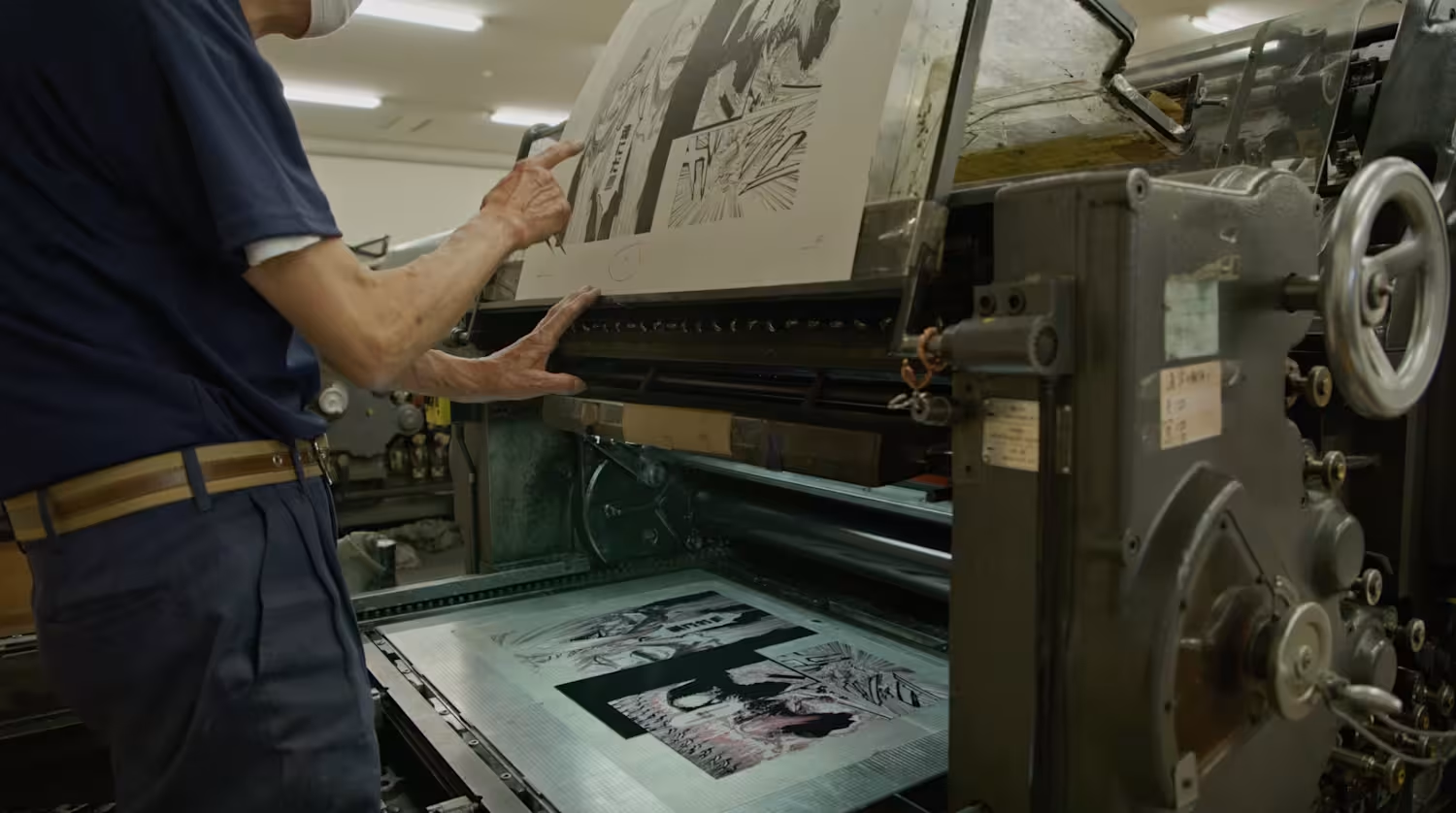
Takaoka: The bearings are very firm, precise, and hard. Many printing machines are said to have a lifespan of about 17 years, but Heidel doesn't have a time limit. In other words, if you use it properly, you can use it for quite a long time.
SMAH: You've been operating a Heidelberg for more than 60 years. Do you replace parts or perform other maintenance work on it?
Kuroyanagi: Yes, we do. When the rollers start to creak, you have to change them. But nowadays, even if you contact Heidelberg, they won't have the parts. They no longer make them.
Takaoka: When we run out of hoses, we sometimes ask a subsidiary of Heidelberg or another company for an order, but they tell us that they don't have any more in stock. We've replaced parts twice before.
SMAH: It's a very durable machine. We hope you will continue to print manga art for us for a long time to come.
Takaoka: It's still in good shape because you are using it beautifully.
Continued in Volume 3
(Composition : Aya Okamura Photo & Movie by Toyokazu Fujita / HIORYES Inc.)
