



SHUEISHA Inc. All rights reserved.

Click here for Volume 1 → Talk on Manga, Art, Music and Blockchain (1)
Communicating "Manga Art"
Okamoto: We had a lot of trouble trying to figure out how to convey the value of manga art, especially considering the COVID-19 pandemic. No matter how thoroughly we explain it, people tell us they just have to see the works in person. Because the works are sold online, it's not really possible to have them view it in person. That's why we started making videos as well as photographs, but then the problem of sound inevitably arose. If the videos were silent, the silence itself would carry a certain meaning. What should be the relationship between sound and images?
Shimooka: That's a difficult question. If you wanted to appeal to the fans of this manga work, you could use the theme song of the anime, however cliché that may seem.
Okamoto: Yeah. But it's not anime.
Shimooka: Right. Thinking about it in a different way, you could take a video of a work being hung up and have whatever background noises that are present be audible.
Okamoto: Like if it were hung up in a restaurant, you would hear the sounds of people dining. You're saying the audio could just be the sounds of where the art can be seen?
Shimooka: Exactly. After talking about this earlier, I keep thinking about the places where the art will be displayed.
Okamoto: This is a little off-topic but think about how musicians perform in many different countries and places. You often find yourself playing the same song in a different situation, don't you? When that happens, what's the relationship between the environment around you and the music?
Shimooka: Hmm, good question. I've been playing for a long time, so there are songs I'm bored of playing. (Laughs) You do the same thing from the beginning to the end of the song. That's part of the reason why we've been reworking our songs more and more in our performances. It's strange, though. I don't know if it's the power of the audience or the unique reverberation in the venue, but there are moments when the song becomes something different. You can't reduce it down to the terms of songs and music.
Okamoto: Books are meant to be read alone, and art is basically meant to be appreciated individually, but music is meant to be performed live, right? I feel like there is no other way to make it work other than to share it with lots of listeners and steadily increase the number of fans. In the past, it might have been possible for one patron to say, "I like this musician, so I'll commission him," and it would come together right away.
Shimooka: Young musicians who are currently enjoying success are so-called digital natives who grew up with the internet and social media, and they often feel that they can make it on their own without getting involved with major record companies. That's why it's becoming harder and harder to say, "I can't do anything like that." I don't know if I can go on unless a patron pays me to just play music. (Laughs) It's like, can you take this money to get rid of all of the noise around me? That's why I'm relying on Shii to succeed.
Shii: What, I'm the patron in this scenario? (Laughs)
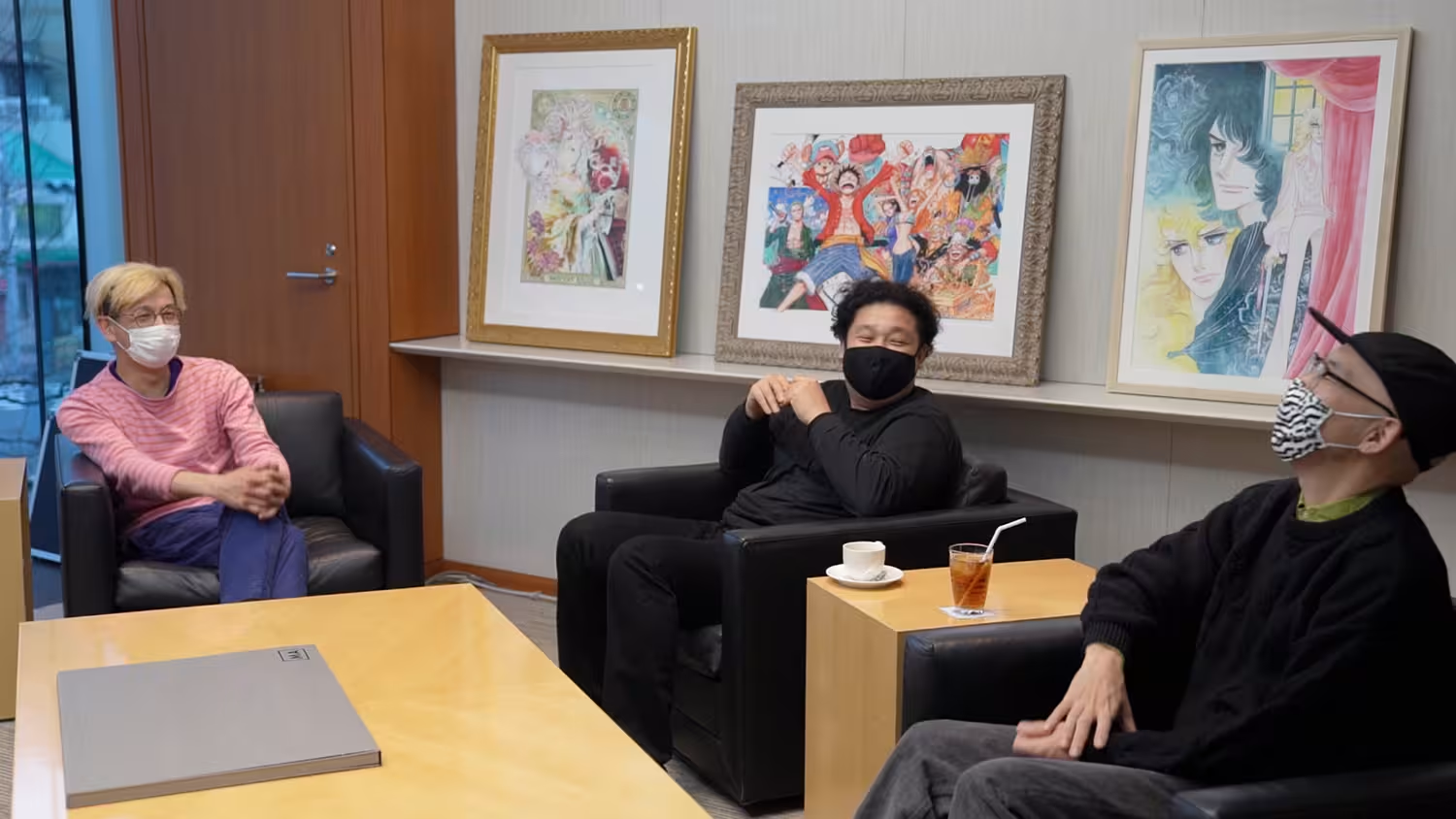
Shimooka: There are things like music distribution, copyright management, and money collection systems that come with music. I wonder if there's a way to improve these systems using blockchain or an approach like that of Startbahn?
Shii: I've heard that if blockchain is introduced into society, copyright management organizations such as JASRAC will become decentralized. I think it would be easier for the organizations if that happened, too. It's just that we're in a transitional phase, and I don't know if it will take 10 years or how long. Record companies have reached out to me too, but so far, I've turned them down. I think we were lucky because we had a new goal to create a place for speculation in art. The music industry has high barriers to entry. The goal to earn money is the same, so when you try to fight for a spot at the table, the politics at work are completely different. I've been doing research, but everything is still up in the air.
Okamoto: The boundaries between music and art are not very clear anymore. I think this is especially true of your work, Shii. Those of us who were around a long time ago are like, "Which part is the work?"
Shii: I get told that a lot even today. (Laughs) For me, I think that the work that symbolizes the times will survive in the world. I create works that are influenced by technology by trying to find what symbolizes this era. In the beginning, I was doing online projects, but it wouldn't really feel right to have those projects displayed in a museum. If there was a computer just sitting there in an exhibition, it wouldn't really make sense. That's when I branched out into creating artwork that evokes the times without using computers or technology, as well as creating infrastructure on the internet. When I first tried to create a work of that nature, I was interviewed by m-Sha.
Okamoto: It's interesting that you're making art on the one hand but creating infrastructure on the other. It's not something that an artist would naturally come up with.
Shii: I learned about this later, but Picasso is said to have invented the current system of galleries, and Sen no Rikyu created an ecosystem centered on tea utensils. Artists have always been trying to create new paradigms. At the root of it, there's a sense of sadism or audaciousness. I've been told by people over and over that my work isn't art, and my response is that their idea of art is different from mine, and that I create new forms of art.
Okamoto: It's like, your work is viewed as a work of art because it's inside this space, but now, the space itself is different.
Shii: Exactly. Your definition is this, but my definition is that. It's not just that you're audacious. It's also that the times are clearly changing, and the dynamism of the internet is developing. Art and the environment around it are changing, and for me, it just seems wrong to keep competing in the same environment.
Okamoto: So blockchain was a solution to that problem.
Shii: Art may be about framing, but it's also about installation and distribution. It's not just a matter of sharing an idea. There are various complex processes of value formation. If you can't manage these processes, it's meaningless to just democratize the presentation and transmission of information. Who had this work in their collection? Where was the work displayed? There are some powerful artists who are able to overcome these things, including the management aspect, but they are few and far between. To find a solution, it was necessary to cross over into many different areas, and it was impossible to do it on a single platform.
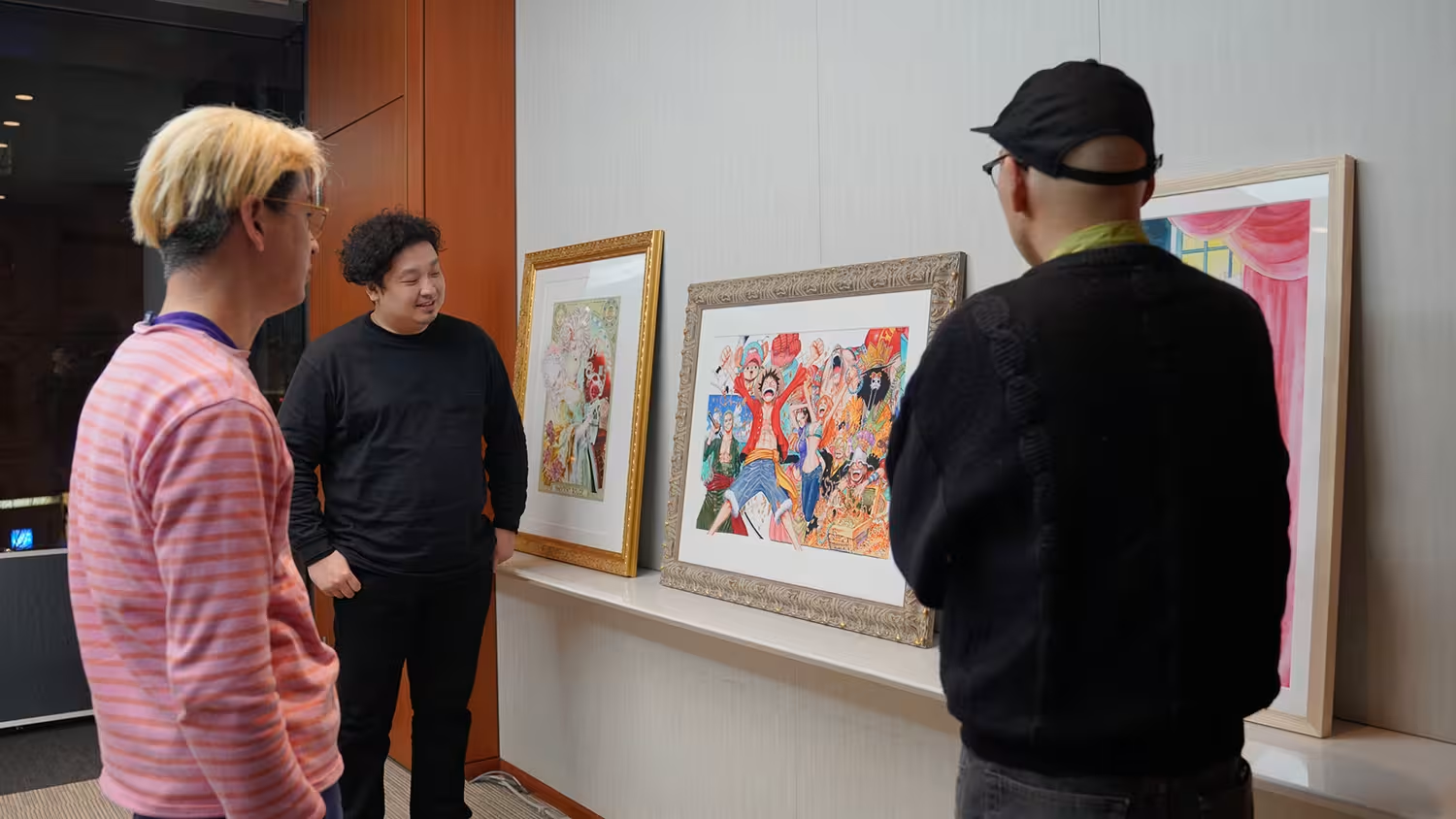
Okamoto: Come to think of it, most fine art is on the secondary market, where it's resold, and not in the galleries where they're initially sold. Items on the primary market don't sell for a lot, either.
Shii: Right. The art world is unique. The primary market has a large number of works, and only a small number of these works make it to the secondary market, so the market value naturally increases.
Okamoto: In the publishing world, works are naturally in the primary market. There are used book markets, but rarely does a used book sell for a high price. I've also heard that these prestigious auctions often do not verify the authenticity of the work.
Shimooka: Wow, is that true?
Shii: Even when the works are appraised, they will not announce the results. Doing so is an examination of the work's history. You find out if it had been through a proper gallery, or if it had been owned by a trusted collector. Just by getting this information, the possibility of counterfeits finding their way into the market is greatly reduced. In that sense, it's a very closed world.
Shimooka: You mentioned that during the m-Sha interview. You said that it was unfair that art could only be judged in the US or London and that you wanted to make the system more fair. Shii was really mad about it.
Shii: Was I? (Laughs)
Shimooka: I sensed that you were really frustrated about it. It made me think of you as a real rebel.
Shii: Hmm. I suppose anger may be one of the feelings that most commonly motivates people.
Okamoto: Personally, I think it's great when an artist's motivation is anger. Punk and rock are more believable. If I had wanted to, I could have used blockchain to create a system like MA somewhere else, but the concept behind this project was to create something new and unprecedented. I prefer the rebel Startbahn way.
Shii: I'm glad I could be a rebel for you. (Laughs)
What is trust in art?
Okamoto: So, Shii, could you give us a simple explanation of blockchain?
Shii: In this context, I think it would be easier to answer, "What is the blockchain that we at Startbahn are working on?"
Okamoto: Please.
Shii: First of all, I felt uncomfortable about the fact that only a few people at the top could deal with art. Through trial and error, I tried to figure out how to make it possible for other people to make decisions and speculate on art. And while I was using technology to figure this out, I came across blockchain. For example, in real estate, a management company goes to the legal affairs bureau to have the government certify that a piece of land is registered to this person, right? Trust is formed because the government is managing the land properly, and when the land passes from one owner to another, the rights can be transferred as a matter of public record. But in the art world, you can't guarantee public trust because there's no singular place to register your artwork. Since trust requires a certain level of publicity, no one will register with me just because I suddenly started telling people I will register their works.
Okamoto: I see. Right.
Shii: But if people from all over the world are involved across various services and institutions, or if responsible people in various countries examine works and make judgments, we can start to establish trust based on new values and publicity. Moreover, if governance and management are conducted by an unspecified number of people around the world, private interests won't be able to make changes or corrections to the data. In other words, it can be treated as a public place by people everywhere.
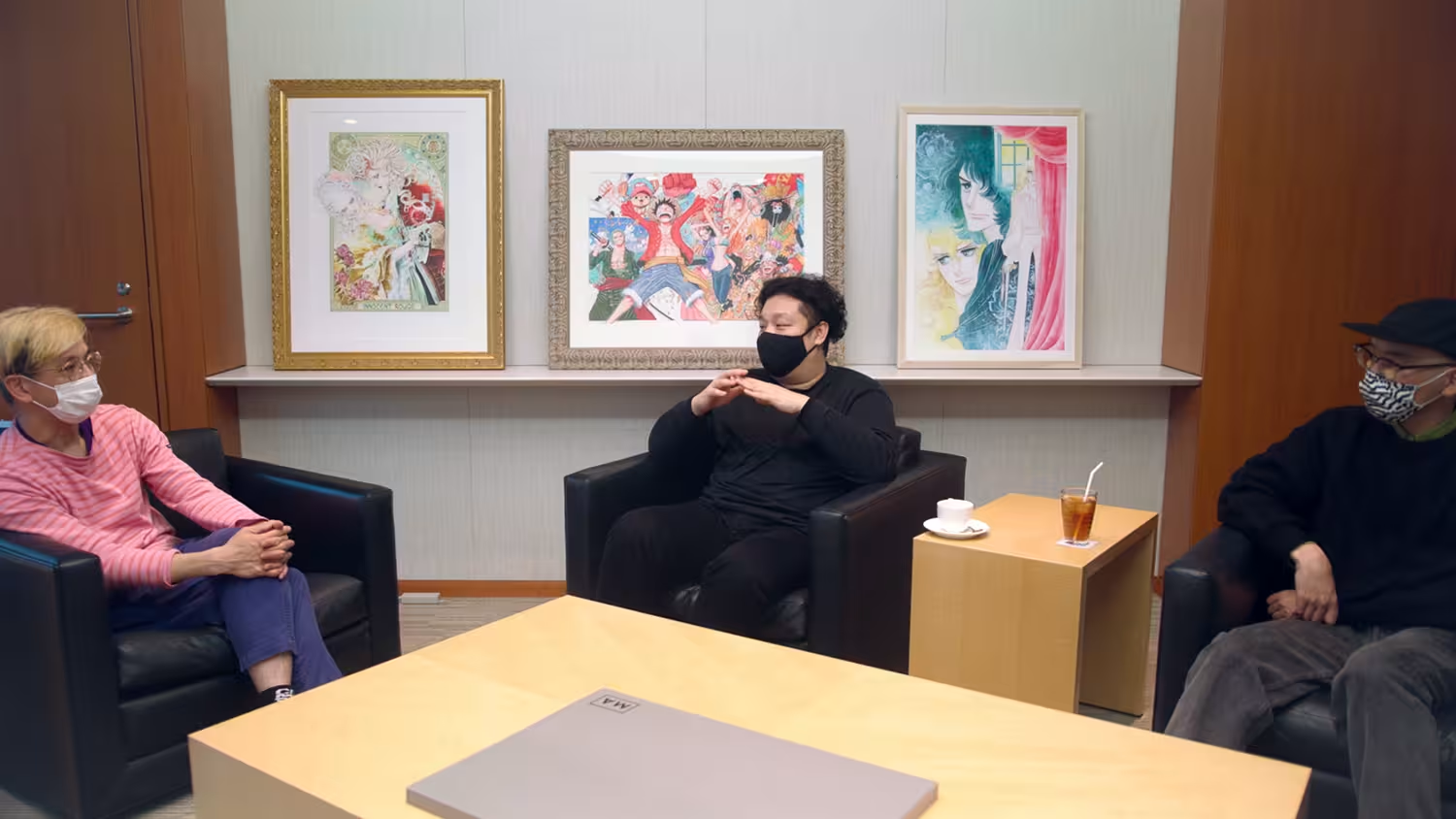
Wikipedia is operated similarly, but because it's funded mainly by donations to the organization, the data will be lost when the money runs out. With blockchain, there are a lot of people all over the world who make money using devices to investigate and verify the data that's tied to it. These people can prove that there is no error in the data.
Okamoto: You're talking about mining.
Shii: That's right. It's permanent because of how it works. Even if a company involved in the blockchain goes out of business, the data would not be lost or be manipulated.
Shimooka: Hmm...
Shii: I guess it gets a little complicated when you actually discuss it. (Laughs)
Shimooka: I can kind of understand it in words, but I can't really grasp how it exists. Did you understand it in the way you just explained it when you first thought that blockchain could solve the problems of the art world?
Shii: No, it was just a hunch. (Laughs) I learned about it long before it became a popular topic, so the engineers I was working with weren't familiar with it. I read carefully through the reference material and thought, "This could be it." Back when the possibility was still very slight, I thought, "Now's my chance," and I went for it with all I had.
Okamoto: You put all your eggs in one basket.
Shii: Yeah. I was lucky, and I hit the jackpot. (Laughs)
Okamoto: (Laughs)
Shii: I had a feeling it would work. I feel like the world has been moving in the same direction from the past to the present. It may be an optimistic view, but I think that the problems of hunger and the frequency of wars are decreasing, and even looking at technology specifically, it's evolving with a wide range of users in mind. The internet is also becoming more and more convenient, and it can be used without specialist knowledge while protecting privacy. In that sense, we're progressing in a very straightforward manner, so we can make guesses about what will happen in the future. When I first learned about blockchain, I imagined it would turn out this way.
Okamoto: The more you go into detail, the dizzier I get. (Laughs) Maybe the fact that we can't use analog metaphors is why it's hard to grasp intuitively. With manga and music, we eventually approach something real, like seeing art on paper or making sounds with an instrument, but blockchain is just code at the end of the day, isn't it?
Shii: When you put it that way, sure.
Okamoto: With no real-world output, when they say ownership will be guaranteed, it makes me think, "Well, what safe will it be stored in?" Of course, I understand that's not what it's about.
Is blockchain something close to the "real world"?
Shii: There has always been this idea that physical things are the strongest. A long time ago, customers used to ask sarcastic questions like, "Well, what happens when the Google servers go down?" or "What happens when the internet disappears?" On the other hand, I've never been asked, "What happens when the real world stops?" In reality, when the COVID-19 pandemic hit, it was the "real world" that stopped. Something that nobody expected happened, and suddenly, technology is being questioned again. I think we need to update the way we think. So, I think that if I were to equate blockchain to something, it would be something close to the "real world." The real world, concrete existence, something like that.
Shii: For example, I took a taxi from my house to this place and stopped at a convenience store before coming in. Just by doing that, I have used the services of multiple companies. I get in the car of a taxi company; I enter the store of a convenience store company. It's the same as going online and logging into or signing up for all of these things. Many different companies and services make the world go around. In the real world, you can roll out of bed and go into a convenience store, buy a sandwich, and get in a taxi. You don't have to log in every time. Currently, each company still has to monetize the data on their own, so they build systems on their websites to collect data, but it's not really necessary. In the real world today, everyone controls their own data, and you can use whatever services you want to without thinking about it. When I think about what blockchain is, I think of it as a technology that can incorporate elements of the real world into the digital world. I think that's probably the best metaphor to use. By using blockchain, I think the digital world will gradually become more and more similar to the real world.
Shimooka: I see. It's something that can constantly prove who you are.
Okamoto: Listening to all this, I can't help but think about whether blockchain will bring more democratization or more tyranny. If you can prove that you are yourself, doesn't that also mean that other people can identify you? Like Shii says, it's convenient because you can use services without logging in. So, what if national identification numbers or IC chips were linked to the blockchain from the time people were born, you know?
Shii: People are cautious of the internet because it's easy to monitor, but in the real world, it's actually a lot easier to take away somebody's privacy. If you want to take something away from someone, you can use violence or force. They say that the amount of loss caused by shoplifting at a physical store is a few percentage points of the store's annual sales, but the likelihood of falling victim to fraud at Yahoo! Auction has dropped to 0.003% as of 13 years ago. And yet, online transactions have a worse reputation. Why is that the case? I think this is a similar idea.
Okamoto: I suppose that newer things are seen as riskier.
Shimooka: Another major factor is that I haven't been able to commit myself to it or touch it at this point. I don't know. You've explained it in such detail, but I'm here trying to reduce it to "blockchain is like a license." (Laughs)
Shii: Sorry, I'm bad at explaining it. (Laughs)
Shimooka: I hope my poor understanding doesn't diminish the impression of blockchain for people reading this.
(Composition: Shigeru Kusamizawa, Photography: Kanon Okamoto)

