


SHUEISHA Inc. All rights reserved.


After Straw Hat Luffy defeats Kaidou in their epic battle above the skies, Wano Country was freed from twenty years of oppressive rule.
It is the world that the Ninja-Pirate-Mink-Samurai Alliance, the retainers, the yakuza, and the people of Wano all dreamed of, fought for, and finally achieved — a world where friends can enjoy eating until they’re full.
From atop a towering drum-lined festival platform reminiscent of Japan's Bon Odori festivals, Luffy leads the toast, pulling even the attacking Kid into the festivities.
“KAMPAI!!!”
“A toast to this party!!!Let’s drink the night away!!!”
With a thunderous boom, massive fireworks erupt in the sky above the Flower Capital, and the crowd raising their cups is swept up in the excitement.
This dynamic illustration seems to leak beyond the frame, making the viewer feel as if they can hear the joyous laughter and festival music.
・Signature on the print (seal)
・Due to the nature of the cotton paper, small black spots may be seen in the work. In addition, subtle color irregularities and small ink droplets may be present as a result of the letterpress printing process. Please be aware of this when applying.
In 1992, Oda received the Weekly Shonen Jump Tezuka Award for Wanted! Serialization of ONE PIECE began five years later in 1997. In the same year, the first tankobon (individual) volume of the series was released. In 1999, the title was made into an animated series. The first ONE PIECE exhibition was held in 2012.
In 1992, Oda received the 2nd place prize in the 44th Tezuka Award for Wanted! (under the pseudonym "Tsuki Himizu Kikondo"). In 1993, Oda was selected for the 104th Hop Step Award for Ikki Yako. In 2006, ONE PIECE was chosen in the Japanese Media Arts Festival 100 Manga Selection. In 2012, Oda received first prize in the 41st Japan Cartoonists Association Award for ONE PIECE. In 2018, Oda received the Kumamoto Prefecture Honorary Award.
The magazine carrying the series was Weekly Shonen Jump, the year the series started was 1997. A heroic pirate adventure story revolving around a treasure known as "One Piece." In this adventure, Monkey D. Luffy sets out to become the King of the Pirates. The work was made into an animated television series in 1999. On June 15, 2015, One Piece attained the Guinness World Record for most copies published for the same comic book series by a single author. The total worldwide circulation exceeds 600 million copies as of March 2026.

活版平台印刷
Since its inception, the black and white storytelling medium known as manga has been produced by the letterpress, the most primitive method of printing. Even today, Shonen Jump and other manga magazines are created using the letterpress rotary printing method commonly known as katsurin.
Letterpress printing is an old-style printing method in which ink adhered to a printing resin plate is transferred by directly pressing the plate onto the paper. The way manga is drawn has evolved to accommodate this method of printing.
One good example is the text. The standard typeface used in manga is called "Anti-Gothi." It is a combination of a sans-serif typeface (often called "Gothic" in Japan) for kanji characters and a serif typeface (Ming) for hiragana and katakana. It is said that this typeface was chosen in the early days of manga production, when they were printed by letterpress, so as not to compromise readability (see Idea, Issue 336, 2009, Seibundo-Shinkosha.) Screen tones also developed with the use of design materials to imitate the gray and other form patterns using letterpresses, which are not capable of printing in gray.
While rotary letterpress printing can only be used with huge rolls of recycled paper for mass production, a flatbed letterpress is capable of printing on a variety of types of paper. Flatbed letterpress machines were employed all over Japan, including in Tokyo, but they have been replaced by offset printing presses, there are only a few large flatbed letterpress machines to be found.
Is it possible to take manga, which has always been a medium optimized for letterpress, and turn it into artworks using the highest possible quality of letterpress? This was the question we wanted to answer.
Using a letterpress machine, the artwork is created using extremely strong pressure on a paper. This creates a unique surface with a physical impact that is impossible to achieve using offset, lithographic, or silkscreen printing. When you touch it, you can see that the printed surface is concave.
The aim of us is to pass on not only compelling manga artwork, but also the printing technology used by rare printing presses to future generations.
Tsutatomo Printing Co., Ltd. (Nagano) Tokyo Letterpress (Kagurazaka) Nikkodo (Asakusa)・Signature on the print (seal)
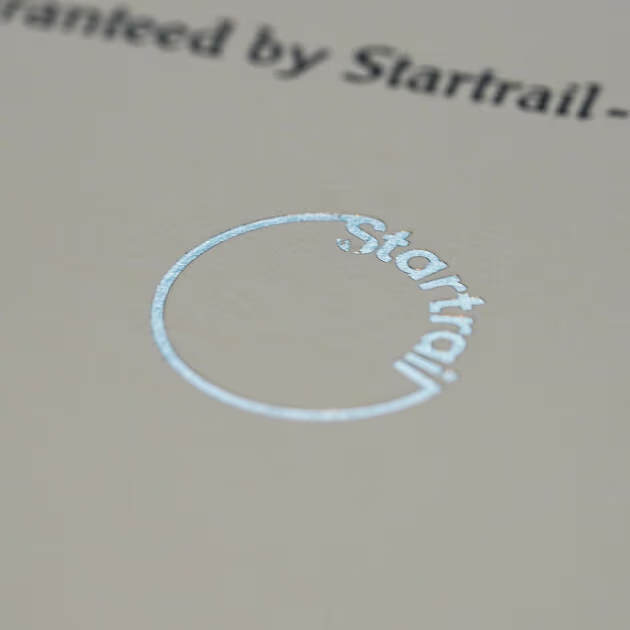
・A blockchain-linked sales certificate (letterpress-printed by the Kazui Press with an embedded
NFC tag seal) is included (one copy).
・The storage case is made with Gmund Gold-FS (Platinum) paper and finished with silver foil.
・The four sides of the works are cut by hand, so there will be individual differences.
・Due to the nature of the cotton paper, small black spots may be seen in the work. In addition, subtle color irregularities and small ink droplets may be present as a result of the letterpress printing process. Please be aware of this when applying.