


SHUEISHA Inc. All rights reserved.


Nami unleashes her technique “Thunder Lance Tempo” in a battle with Kalifa, who has the power of the Bubble-Bubble Fruit. The vanishing point of the focus lines is near the center of the speech bubble, and our eyes are naturally drawn to the name of her move. The distinctive typeface "GONA IN INNAG" features thin white lines running through black blocks of text. It almost appears as if electricity is running through the letters.
On this page, the characters, the sound-effect lettering, and the speech bubbles are all arranged above focus lines creating a three-dimensional effect. The sound effects "BOOM [D’on]!!" and "Zap, Zap, Zap, Zap [Bari Bari Bari Bari]," are drawn in varying sizes, with drawn characters overlapping each other. We sense the spatial and temporal back and forth and hear the sounds through our eyes. Nami burst through the sound effects. Her left arm extends straight. A Log Pose can be seen on her wrist.
A navigator who reads and controls the weather, Nami stars in this impressive scene creating a striking work of art.
Signature on the print (seal)
Due to the nature of the cotton paper, small black spots may be seen in the work. In addition, subtle color irregularities and small ink droplets may be present as a result of the letterpress printing process. Please be aware of this when applying.
In 1992, Oda received the Weekly Shonen Jump Tezuka Award for Wanted! Serialization of ONE PIECE began five years later in 1997. In the same year, the first tankobon (individual) volume of the series was released. In 1999, the title was made into an animated series. The first ONE PIECE exhibition was held in 2012.
In 1992, Oda received the 2nd place prize in the 44th Tezuka Award for Wanted! (under the pseudonym "Tsuki Himizu Kikondo"). In 1993, Oda was selected for the 104th Hop Step Award for Ikki Yako. In 2006, ONE PIECE chosen in the Japanese Media Arts Festival 100 Manga Selection. In 2012, Oda received first prize in the 41st Japan Cartoonists Association Award for ONE PIECE. In 2018, Oda received the Kumamoto Prefecture Honorary Award.
The magazine carrying the series was Weekly Shonen Jump, The year the series started was 1997. A heroic pirate adventure story revolving around a treasure known as "One Piece." In this adventure, Monkey D. Luffy sets out to become the King of the Pirates. The work was made into an animated television series in 1999. On June 15, 2015, One Piece attained the Guinness World Record for most copies published for the same comic book series by a single author. The total worldwide circulation exceeds 500 million copies as of August 2022.


A Surface with a Physical Impact
With the cooperation of Kyodo Printing Co., Ltd., the company that prints Weekly Shonen Jump, we found a working letterpress flatbed press and the skilled staff able to run the press at Tsutatomo Printing Co., Ltd. in Nagano. Using a letterpress machine manufactured in Germany in the 1960s, the artwork is created using extremely strong pressure on Gmund Cotton Max White, a type of art paper made from 100% cotton. This creates a unique surface with a physical impact that is impossible to achieve using offset, lithographic, or silkscreen printing. When you touch it, you can see that the printed surface is concave.
In spring 2023, we received word that Tsutatomo Printing was ceasing operations, and after an urgent search for a company capable of letterpress printing, we found two companies in Tokyo. Tokyo Letterpress (Kagurazaka) operates a German-made printing press. Nikkodo (Asakusa) uses a Japanese-made printing press. Both are valuable printing machines with different features and methods of printing. With the cooperation of each company, verification and research have enabled us to continue producing "The Press" series.
The aim of this collection is to pass on not only compelling manga artwork, but also the printing technology used by rare printing presses to future generations.
Revisiting manga's roots with flatbed letterpress printing
Since its inception, the black and white storytelling medium known as manga has been produced by the letterpress, the most primitive method of printing. Even today, Shonen Jump and other manga magazines are created using the letterpress rotary printing method commonly known as katsurin.
However, flatbed letterpress machines, which were once frequently used for proof printing and small print jobs, are rarely in use today. These machines, especially those capable of printing in A2 size, are in very limited operation in Japan and around the world.
Is it possible to take manga, which has always been a medium optimized for letterpress, and turn it into artworks using the highest possible quality of letterpress?
This was the question we wanted to answer.
The original box includes a blockchain-linked sales certificate
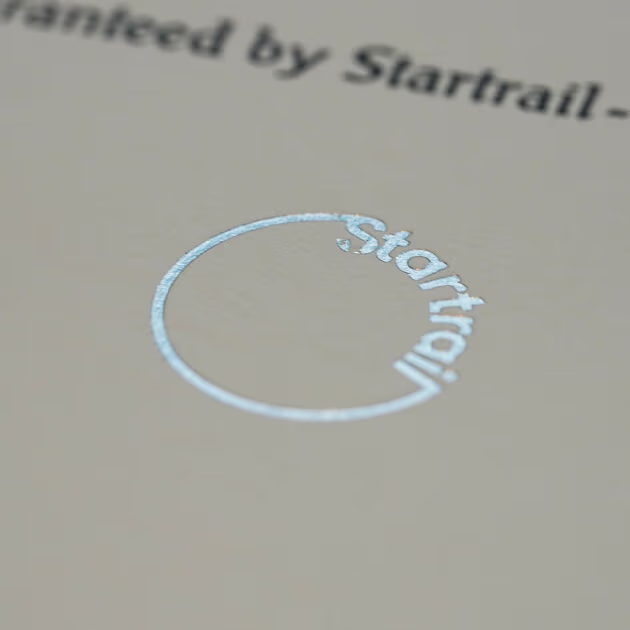
All works are registered to Startrail PORT, NFT management service. Works include a blockchain-linked sales certificate with an affixed NFC tag sticker (letterpress printed by Kazui Press). You can view the information recorded on the NFT by scanning the NFC tag sticker with a smartphone. We will send you your product in an original Shueisha Manga-Art Heritage box created by Misuzudo.
Work Size A2 (420 mm x 594 mm)
Paper Used Gmund Cotton Max White
Printing Method Letterpress printing
Package Contents
Main product
Blockchain-linked sales certificate (letterpress printed by Kazui Press, linked with NFC tag sticker)
Matte paper
Special paper to absorb harmful substances
Instruction manual
Storage case