


SHUEISHA Inc. All rights reserved.


This was the frontispiece illustration for Issue 42, 1972 (October 2 Issue) of Weekly Shonen Jump. In 2024, we photographed the illustration using a high-resolution camera. We then digitally retouched the photograph and printed it on 100% cotton paper using an archival inkjet printer. It has been turned into a manga-art piece, packaged as a set containing the illustration in its original size and an enlarged A1-size version.
The cover of the same issue features the illustration that namede later "Mazinger Z: Giant Machine God" (MAZ_RC_003_A1). When you turn the cover page, this illustration appears along text that reads “Thrilling New Series!” and “Sci-Fi Robot Manga Mazinger Z.”
The background is green. We see the black figure of a giant robot. There are gleaming yellow eyes. Their red outlines are reminiscent of kumadori makeup used in kabuki performances. Kuma refers to the boundaries between light and shadows, and the red beniguma represents a sense of justice and courage in kabuki. Koji Kabuto steps forward, raising both hands in the air as if he were clawing at something. Perhaps he has the ability to control forces that can be either divine or demonic.
What you see on the right is a submission stamp for Shonen Jump. It reads, “Shonen Jump... Manuscript.” It is customary for the text of a serial work to be labeled with this type of stamp, which indicates the issue of publication and other information. To highlight the uniqueness of original manga artwork in the form of a printed manuscript, we printed the work with a preserved image of the submission stamp.
During the process, Go Nagai himself gave the work the title Mazinger Z: Darkness of Spirit.
*The work is made up of a set of 2prints
*Signature on prints (seal)
Go Nagai made his manga debut with Meakashi Polikichi (serialized in Bokura) in 1967. In 1968, he began publishing Harenchi Gakuen in Weekly Shonen Jump. The series was a tremendous hit. In 1972, he launched two series, Devilman in Weekly Shonen Magazine and Mazinger Z in Weekly Shonen Jump, while the animated versions were being developed for television simultaneously. In 1973, he started serializing Cutie Honey in Weekly Shonen Champion. His works span a wide range of genres, from gag comedy to dark fantasy, science fiction, and horror. As of 2024, he continues to publish series. In 2019, he was awarded the Order of Arts and Letters (Chevalier) by the French government.
The protagonist rides on a giant robot, battling strange enemies.
In 1972, Go Nagai launched both the TV animation and manga series projects at the same time. By bridging the story’s world with character merchandise, this franchise created a giant robot universe and a new market, which continues to thrive today. This paved the way for such series as Getter Robo (1974–), Mobile Suit Gundam (1979–), and Neon Genesis Evangelion (1995–).
Mazinger Z was followed by the sequels Great Mazinger (1974) and UFO Robot Grendizer (1975–), which were big hits in Asia, Europe, and Latin America. In 2024, Grendizer was rebooted as the animated series Grendizer U.

アーカイヴァル インクジェット プリント
Shueisha Manga-Art Heritage has entered into a business partnership with Epson, entrusting them with color management support and printing. The pigment inks used in the company’s inkjet printers are lightfast, preserving the original colors even under lighting that would cause the dye-based color inks used in the original artwork to fade.

Inkjet printing is a printing technology in which minute ink particles are ejected directly onto media such as paper and fixed in place. There are two main methods of carrying out this process: the thermal method and the piezo method. In the thermal method, ink is heated to create bubbles, which are then used to eject the ink. In the piezo method, ink is ejected by the force of a piezoelectric element, a material that deforms when a voltage is applied. Epson has adopted and further developed the piezoelectric method, establishing it as its proprietary Micro Piezo technology.
One of the advantages of the piezo method is its greater compatibility with a wide range of ink compositions. Since the ink is not heated, the method can accommodate components that are resistant to boiling, including oil-based pigments. For this reason, Epson has sought to develop prints that are more lightfast and weather-resistant. In particular, prints made with pigment inks are excellent for preservation.
*Please note that we cannot guarantee light resistance under strong ultraviolet rays or durability in environments with high temperature and humidity. We recommend using an acrylic frame with UV protection for display purposes.
On the other hand, original manga artwork is highly prone to fading, especially when it comes to color illustrations created using dye-based markers. Illustrations created for the covers of manga magazines, frontispieces, and comic book covers were not originally intended to be displayed or appreciated as works of art. They were designed to be printed and viewed by readers in magazines and comic books. Illustrations were often colored over copied line art, and in some cases, the characters and backgrounds were cut out and pasted in separately. To transform such illustrations into manga-art, they need to be retouched, such as by correcting discolored areas.
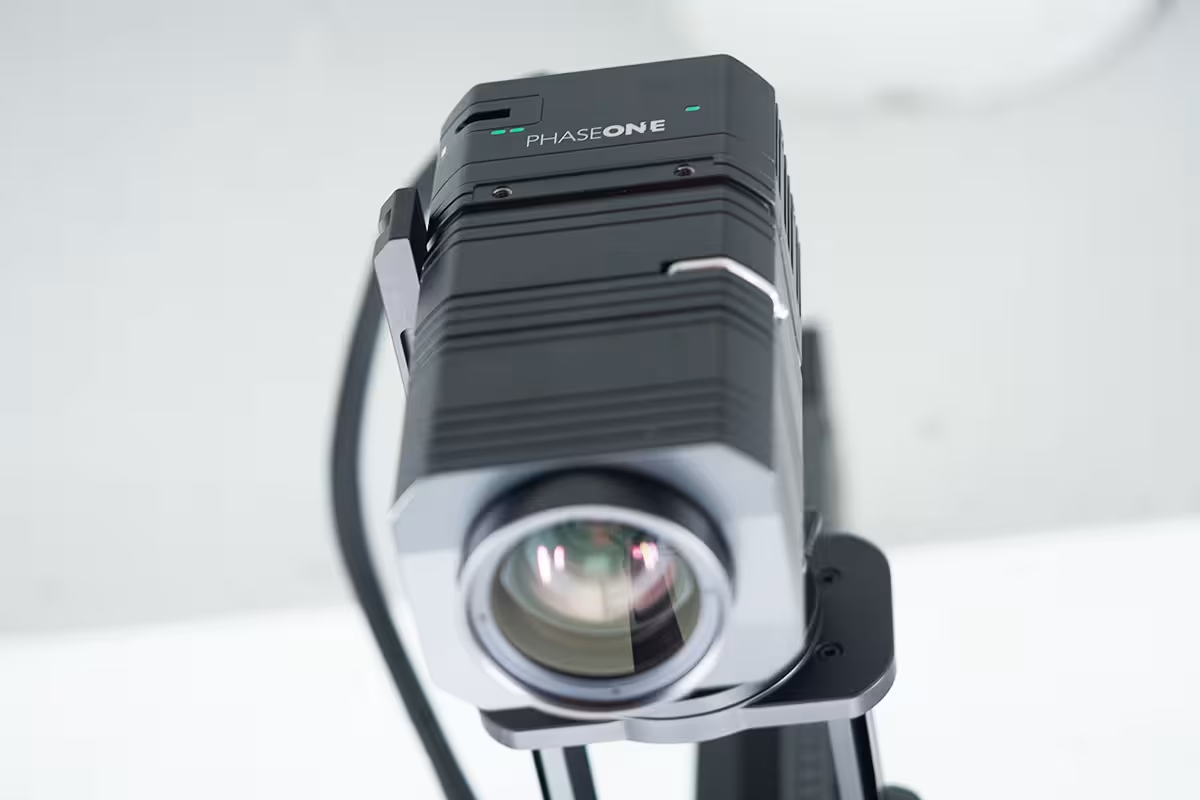
Since 2008, Shueisha has been working to digitally archive manga. Initially, we captured color originals using the EverSmart Supreme II, a high-precision scanner, and in 2015, we began using the Phase One IQ180, a high-resolution digital camera. Since 2020, we have been using Phase One iXH, Cultural Heritage series. This has allowed us to capture and preserve colors beyond the reproducible range of commercial printing, while also retaining the texture of the paper on which the illustrations were created.
Using this digitally archived data and imaging equipment, we retouch the artwork, restoring the original colors as they were when the illustrations were created. To produce the final print, color is carefully managed at each stage, from the original artwork to the captured data and printing.
For illustrations that were created digitally, we perform color management and printing in the wider-gamut Adobe RGB color space, instead of the sRGB space typically used in commercial printing, resulting in deeper and more vibrant colors.