


SHUEISHA Inc. All rights reserved.


This series of lithograph works depicts characters from JoJo’s Bizarre Adventure together with
their Stands, which were introduced in Part 3, Stardust Crusaders. The first release is a set
featuring the following three works.
Jotaro Kujo / Star Platinum
DIO / The World
Josuke Higashikata / Shining Diamond
・Signature on the print (seal)
・A blockchain-linked sales certificate (letterpress-printed by the Kazui Press with an embedded
NFC tag seal) is included (one copy).
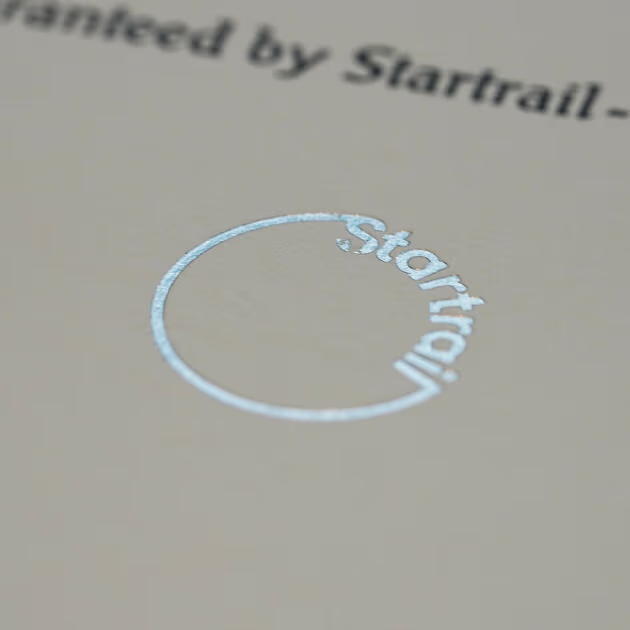
・The storage case is made with Gmund Gold-FS (Platinum) paper and finished with silver foil.
・The four sides of the works are cut by hand, so there will be individual differences.
・Due to the nature of the cotton paper, small black spots may be seen in the work. In addition, subtle color irregularities and small ink droplets may be present as a result of the lithograph printing process. Please be aware of this when applying.
In 1980, Araki received the runner-up prize at the 20th Tezuka Award for his debut work Poker Under Arms, which was published in Weekly Shonen Jump. In 1986, he started the series JoJo’s Bizarre Adventure in the same magazine. Cumulative circulation of the series has surpassed 120 million copies. As of 2026, he is currently serializing The JOJOLands in the monthly magazine Ultra Jump.
In 2009, he participated in an exhibition at the Louvre Museum, where Rohan Kishibe Goes to the Louvre (Rohan au Louvre) was unveiled. In 2013, collaborative works he created with Gucci were showcased worldwide in the fashion brand’s directly operated stores. In 2018, the Hirohiko Araki JoJo Exhibition: Ripples of Adventure was held in the National Art Center, Tokyo. This was the first time that a solo exhibition of an active manga artist has been held at a national art museum.
Hirohiko Araki's masterpiece. The series has over 100 volumes in total. Across time and countries, the protagonist, nicknamed "JoJo," fights alongside his friends to face his nemesis. As of 2026, the ninth part of the series, "The JOJOLands," is currently being serialized in Ultra Jump.

リトグラフ プリント
Lithography is a printing technique with a history dating back more than two centuries. The Japanese term for lithograph, sekiban-ga, literally translates to “stone plate picture.” As this term suggests, the medium originated as a technique to transfer images drawn on stones onto paper. Lithography began to be used as an industrial technique because it allows images to be reproduced more easily than etching (copperplate engraving), which requires a high level of skill from the artist. Starting in the 19th century, artists like Edgar Degas (1834–1917) began to explore the medium, working with printmakers to produce unique prints that were only possible with this technique. These prints gradually came to be recognized as works of art.
Lithograph printing at Itazu Litho TokyoIn modern printing, the original artwork is photographed or scanned to create a plate for printing, but in lithography, the artist draws the image directly on the plate. Nowadays, artists often draw on metal plates instead of stone ones, but the practice of drawing images directly on the plate remains unchanged. The images are made with lithographic pencils or chalk and transferred to paper, and because of this drawing technique, they have the same texture as artwork that has been drawn directly on paper.
These works were made with lithographic pencils and chalk, and the lines drawn by the artist are faithfully rendered. Once drawn, lines cannot be removed with an eraser or anything else. As such, the artists move their hands with a sense of pressure. However, this allows us to feel the boldness of slowly drawn lines, the precision and comfort of the faster ones, and the rhythm of the rough shadows.