


SHUEISHA Inc. All rights reserved.


Kiwako Imoto straddles a V engine with a skull with goggles.
This illustration was created for the cover of the second volume of Biorg Trinity manga.
Kiwako is a Bugrar who has the ability to fuse with motorcycles. In the story, metal arms extend from her arms and legs, and she is depicted speeding through space rotating a hollow wheel. In this illustration, however, she has yet to fuse with the motorcycle, and the machinery that connects to the engine is depicted in the mechanical and surgical-style drawings behind her.
The cloth around the green-haired Kiwako's neck looks like the collar of a sailor suit, and her bra and boots are decorated with colorful skulls reminiscent of the Mexico’s Day of the Dead.
The army green belt extends from her chest and is draped over her thighs and resembles a parachute belt. It's unclear whether these items are practical or fashion, but they accentuate the character's appeal.
The colorful stickers decorate the giant hammer with the words "RIDERS," "CRASHER," "SPEEDBOY" and "AIR." The fact that it is practically overkill is indeed what makes it so appealing.
This illustration is filled with Oh!great's edgy adolescent charm.
*The work is made up of a set of 2prints
*Signature on prints (handwritten)
Oh!great made his debut in 1995 with SEPTEMBER KISS, which appeared in Manga Hot Milk (Byakuya-Shobo).
He has serialized Tenjho Tenge and Biorg Trinity (co-created with Otaro Maijo) in Ultra Jump (Shueisha), and Air Gear in Weekly Shonen Magazine (Kodansha). He won the 30th Kodansha Manga Award in the shonen category for Air Gear.
He has also designed numerous characters for anime and games. He is currently serializing Bakemonogatari (original story by Ishin Nishio) in Weekly Shonen Magazine.
The Bio Bug is a disease that causes holes to appear in both palms and allows people to inhale and fuse with whatever they want. Featuring an ensemble of characters, the series is a coming-of-age drama set in a world with a fragile balance. It's a challenging work jointly created by the novelist Otaro Maijo and Oh!great with the aim of making a novel in the form of manga, rather than the manga version of a novel.

アーカイヴァル インクジェット プリント
Shueisha Manga-Art Heritage has entered into a business partnership with Epson, entrusting them with color management support and printing. The pigment inks used in the company’s inkjet printers are lightfast, preserving the original colors even under lighting that would cause the dye-based color inks used in the original artwork to fade.

Inkjet printing is a printing technology in which minute ink particles are ejected directly onto media such as paper and fixed in place. There are two main methods of carrying out this process: the thermal method and the piezo method. In the thermal method, ink is heated to create bubbles, which are then used to eject the ink. In the piezo method, ink is ejected by the force of a piezoelectric element, a material that deforms when a voltage is applied. Epson has adopted and further developed the piezoelectric method, establishing it as its proprietary Micro Piezo technology.
One of the advantages of the piezo method is its greater compatibility with a wide range of ink compositions. Since the ink is not heated, the method can accommodate components that are resistant to boiling, including oil-based pigments. For this reason, Epson has sought to develop prints that are more lightfast and weather-resistant. In particular, prints made with pigment inks are excellent for preservation.
*Please note that we cannot guarantee light resistance under strong ultraviolet rays or durability in environments with high temperature and humidity. We recommend using an acrylic frame with UV protection for display purposes.
On the other hand, original manga artwork is highly prone to fading, especially when it comes to color illustrations created using dye-based markers. Illustrations created for the covers of manga magazines, frontispieces, and comic book covers were not originally intended to be displayed or appreciated as works of art. They were designed to be printed and viewed by readers in magazines and comic books. Illustrations were often colored over copied line art, and in some cases, the characters and backgrounds were cut out and pasted in separately. To transform such illustrations into manga-art, they need to be retouched, such as by correcting discolored areas.
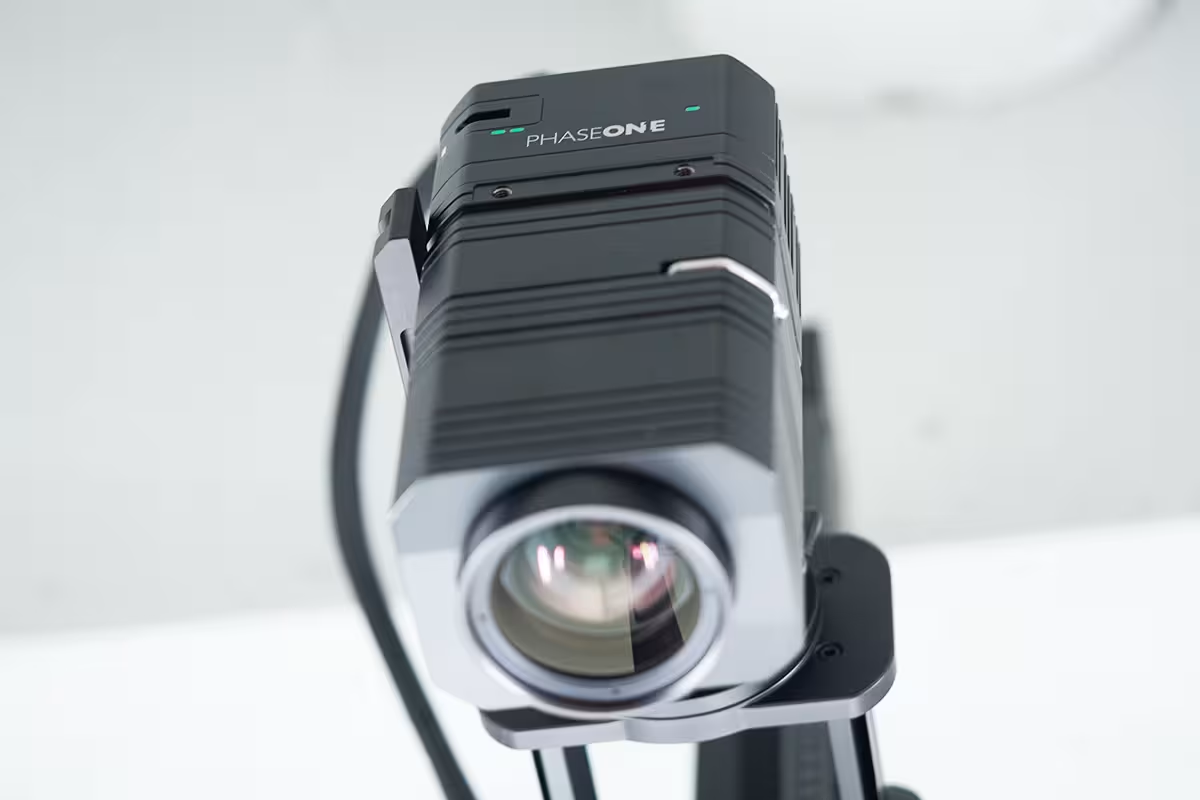
Since 2008, Shueisha has been working to digitally archive manga. Initially, we captured color originals using the EverSmart Supreme II, a high-precision scanner, and in 2015, we began using the Phase One IQ180, a high-resolution digital camera. Since 2020, we have been using Phase One iXH, Cultural Heritage series. This has allowed us to capture and preserve colors beyond the reproducible range of commercial printing, while also retaining the texture of the paper on which the illustrations were created.
Using this digitally archived data and imaging equipment, we retouch the artwork, restoring the original colors as they were when the illustrations were created. To produce the final print, color is carefully managed at each stage, from the original artwork to the captured data and printing.
For illustrations that were created digitally, we perform color management and printing in the wider-gamut Adobe RGB color space, instead of the sRGB space typically used in commercial printing, resulting in deeper and more vibrant colors.