


SHUEISHA Inc. All rights reserved.


The night is blue. The trees are black.
White snow flutters in the air, which is cool and clear.
Are they on their first shrine visit of the New Year?
Wearing a bright pink kimono, Orihime Inoue takes a bite of cotton candy.
Ichigo Kurosaki walks slightly ahead, draped in a haori with a white snake on it. Renji Abarai wears a black haori with brown fur over a red kimono.
Rukia Kuchiki runs toward the shrine, spreading her long-sleeved kimono out like wings.
Dressed in kariginu, Yasutora Sado and Uryu Ishida wait for everyone in front of the curtains of the shrine, with the shrine bell in between them.
The rest are only a short distance away from where the two wait.
With Ichigo and Orihime looking toward the viewer, it feels as if you are visiting the shrine with them.
The original illustrations were created on two sheets of paper, but digital retouching was performed to make them appear connected as one work of art.
*The work is made up of a set of 2prints
*Signature on prints (seal)
Kubo debuted in 1996 with Ultra Unholy Hearted Machine (published in Weekly Shonen Jump Summer Special). He published BLEACH in Weekly Shonen Jump between 2001 and 2016,. In 2018, he released a new work, Burn the Witch. Recently, in 2021, a new episode titled "BLEACH: New Breaths from Hell" was released.
Kubo won the 50th Shogakukan Manga Award for BLEACH in 2005. And in 2008, he received the Comic-Con International Inkpot Award.
BLEACH is essentially a battle action story that follows the life of the protagonist, Ichigo Kurosaki, who has suddenly gained Shinigami powers. The story linedepicts the growth of Ichigo and his friends as they battle evil spirits called Hollows and other Shinigami adversaries. The manga was made into an animated television series in 2004. The manga series concluded in 2016. The total worldwide circulation of the 74 BLEACH mangavolumes (tankobon) exceeded 130 million copies as of December 2022. A new episode, "BLEACH: New Breaths from Hell," was published in the 36th and 37th issues of Weekly Shonen Jump in 2021 (it went on sale August 10). In December 2021, an exhibition of the original artwork was held to commemorate the 20th anniversary of the initial publication of BLEACH.In 2022, The anime "BLEACH :Thousand-Year Blood War" was released.

アーカイヴァル インクジェット プリント
Shueisha Manga-Art Heritage has entered into a business partnership with Epson, entrusting them with color management support and printing. The pigment inks used in the company’s inkjet printers are lightfast, preserving the original colors even under lighting that would cause the dye-based color inks used in the original artwork to fade.

Inkjet printing is a printing technology in which minute ink particles are ejected directly onto media such as paper and fixed in place. There are two main methods of carrying out this process: the thermal method and the piezo method. In the thermal method, ink is heated to create bubbles, which are then used to eject the ink. In the piezo method, ink is ejected by the force of a piezoelectric element, a material that deforms when a voltage is applied. Epson has adopted and further developed the piezoelectric method, establishing it as its proprietary Micro Piezo technology.
One of the advantages of the piezo method is its greater compatibility with a wide range of ink compositions. Since the ink is not heated, the method can accommodate components that are resistant to boiling, including oil-based pigments. For this reason, Epson has sought to develop prints that are more lightfast and weather-resistant. In particular, prints made with pigment inks are excellent for preservation.
*Please note that we cannot guarantee light resistance under strong ultraviolet rays or durability in environments with high temperature and humidity. We recommend using an acrylic frame with UV protection for display purposes.
On the other hand, original manga artwork is highly prone to fading, especially when it comes to color illustrations created using dye-based markers. Illustrations created for the covers of manga magazines, frontispieces, and comic book covers were not originally intended to be displayed or appreciated as works of art. They were designed to be printed and viewed by readers in magazines and comic books. Illustrations were often colored over copied line art, and in some cases, the characters and backgrounds were cut out and pasted in separately. To transform such illustrations into manga-art, they need to be retouched, such as by correcting discolored areas.
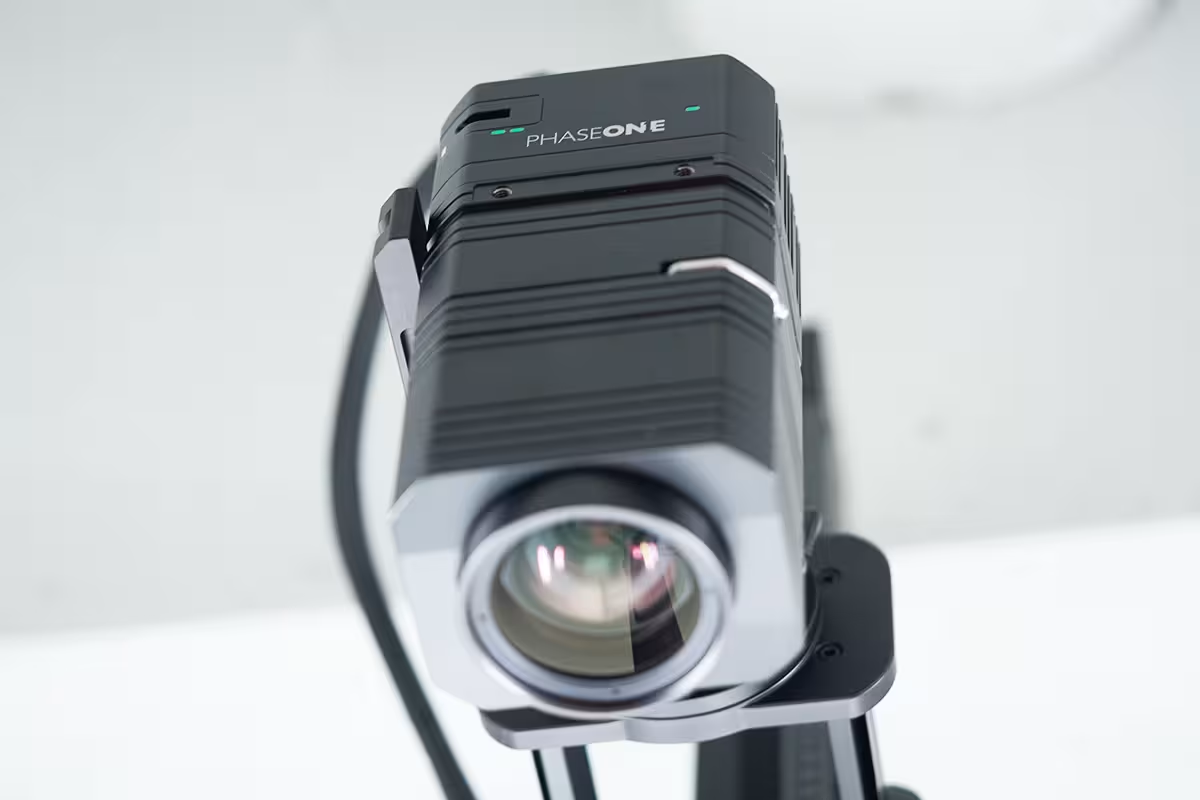
Since 2008, Shueisha has been working to digitally archive manga. Initially, we captured color originals using the EverSmart Supreme II, a high-precision scanner, and in 2015, we began using the Phase One IQ180, a high-resolution digital camera. Since 2020, we have been using Phase One iXH, Cultural Heritage series. This has allowed us to capture and preserve colors beyond the reproducible range of commercial printing, while also retaining the texture of the paper on which the illustrations were created.
Using this digitally archived data and imaging equipment, we retouch the artwork, restoring the original colors as they were when the illustrations were created. To produce the final print, color is carefully managed at each stage, from the original artwork to the captured data and printing.
For illustrations that were created digitally, we perform color management and printing in the wider-gamut Adobe RGB color space, instead of the sRGB space typically used in commercial printing, resulting in deeper and more vibrant colors.