



SHUEISHA Inc. All rights reserved.

Hirohiko Araki
New art prints by Hirohiko Araki (JoJo’s Bizarre Adventure) will be exhibited at Higashi Honganji Temple (Kyoto).Nine lithographic works and nine lenticular works will be on display.
Lithographic Works
Starting in June 2025, Hirohiko Araki illustrated nine lithographic prints. At the request of Shueisha Manga-Art Heritage, he produced his first-ever works for lithographic plates.
Lithography is a printing technique with a history dating back more than two centuries. The Japanese term for lithograph, sekiban-ga, literally translates to “stone plate picture.” As this term suggests, the medium originated as a technique to transfer images drawn on stones onto paper. Lithography began to be used as an industrial technique because it allows images to be reproduced more easily than etching (copperplate engraving), which requires a high level of skill from the artist. Starting in the 19th century, artists like Edgar Degas (1834–1917) began to explore the medium, working with printmakers to produce unique prints that were only possible with this technique. These prints gradually came to be recognized as works of art.
In modern printing, the original artwork is photographed or scanned to create a plate for printing, but in lithography, the artist draws the image directly on the plate. Nowadays, artists often draw on metal plates instead of stone ones, as Araki did for this series, but the practice of drawing images directly on the plate remains unchanged. The images are made with lithographic pencils or chalk and transferred to paper, and because of this drawing technique, they have the same texture as artwork that has been drawn directly on paper.
Hirohiko Araki started serializing JoJo’s Bizarre Adventure in Weekly Shonen Jump in 1986. The ninth part, titled The JOJOLands, is currently being published in the monthly magazine Ultra Jump. A Stand appears in the third part, Stardust Crusaders. It always remains at its owner’s side as it fights. They can take various forms, including liquids, gases, and machines, as well as humanoid forms.
For his first lithographic work, Hirohiko Araki chose to depict the following characters and Stands.
Jotaro Kujo / Star Platinum
DIO / The World
Josuke Higashikata / Shining Diamond
Giorno Giovanna / Golden Wind
Cujoh Jolyne / Stone Ocean
Funny Valentine / D4C
Rohan Kishibe / Heaven’s Door
Yasuho Hirose / Baisley Park
Dragona Joestar / Smooth Operators
The main story pages of manga are usually illustrated in black and white. In the plate-making process, the illustrations are converted into clear black-and-white binary data and printed by letterpress. In other words, the subtle shading of pencil and ink is not captured.
These works were made with lithographic pencils and chalk, and the lines drawn by the artist are faithfully rendered. Once drawn, lines cannot be removed with an eraser or anything else. As such, the artists move their hands with a sense of pressure. However, this allows us to feel the boldness of slowly drawn lines, the precision and comfort of the faster ones, and the rhythm of the rough shadows.
The prints were made by Satoru Itazu (Itazu Litho TOKYO). A hundred copies will be produced for each of the nine works.
Lenticular Works
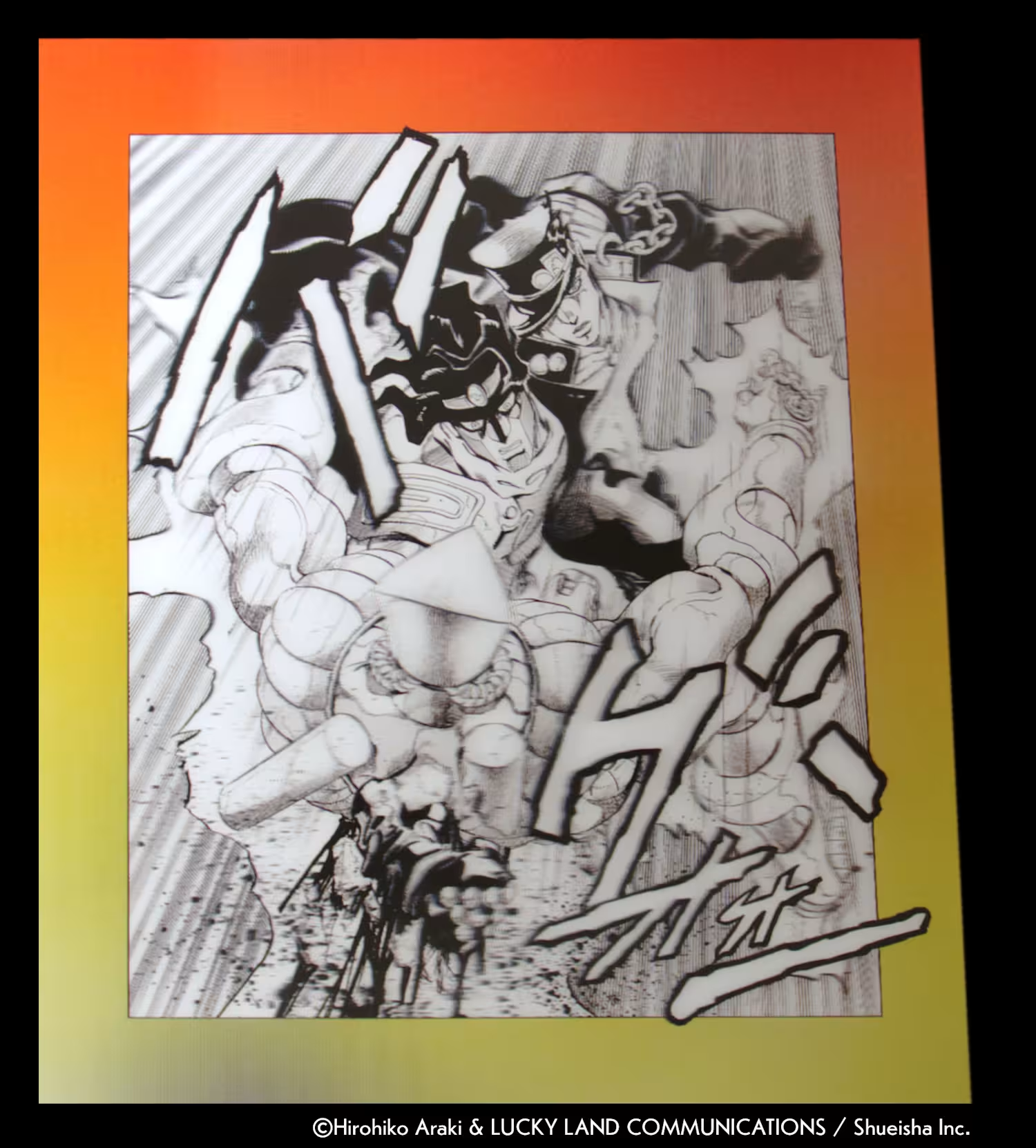
Lenticular printing is a technique in which sheets called lenticular lenses are affixed to create the illusion of motion or depth. In this series, we use the technique to make images appear three-dimensional.
Lenticular prints create the illusion of depth due to the parallax of human binocular vision, but this effect cannot be captured with a single-lens camera. The full effect is only revealed when the print is directly viewed with the human eye. This technique, which uses devices known as parallax barriers, is more than 100 years old. A U.S. patent application was filed in 1915, and a studio offering 3D lenticular printing services opened in Paris in the 1940s. In the 1960s, it became possible to mass-produce colored lenticular prints, sparking its explosive popularity. Many prints were made as picture postcards and other souvenirs, but when large-format printing became possible, the technique began to be used for fine art prints as well.
For these works, Araki selected impressive scenes featuring the main characters from Parts 1 to 9.
Part 1. Jonathan Joestar
Part 2. Joseph Joestar
Part 3. Jotaro Kujo / Star Platinum
Part 4. Josuke Higashikata / Shining Diamond
Part 5. Giorno Giovanna / Golden Wind
Part 6. Cujoh Jolyne / Stone Ocean & Ermes Costello / Smack
Part 7. Johnny Joestar / Tusk Acts 4
Part 8. Josuke Higashikata 8 / Soft & Wet
Part 9. Jodio Joestar / November Rain
As you move closer or farther away, or walk left or right, you are able to view what should be a momentary scene in an extended stretch of time. The fusion of manga as an expressive medium with the technique of lenticular printing will offer a brand-new experience.
After the San Francisco exhibition, a traveling exhibition will come to the Shiroshoin of Higashi Hongan-ji Temple in conjunction with ACK 2025 in Kyoto in November. Lottery sales of these works are also planned to begin in November on Shueisha Manga-Art Heritage (https://mangaart.jp).
In 1980, Araki received the runner-up prize at the 20th Tezuka Award for his debut work Poker Under Arms, which was published in Weekly Shonen Jump. In 1986, he started the series JoJo’s Bizarre Adventure in the same magazine. Cumulative circulation of the series has surpassed 120 million copies. As of 2026, he is currently serializing The JOJOLands in the monthly magazine Ultra Jump.
In 2009, he participated in an exhibition at the Louvre Museum, where Rohan Kishibe Goes to the Louvre (Rohan au Louvre) was unveiled. In 2013, collaborative works he created with Gucci were showcased worldwide in the fashion brand’s directly operated stores. In 2018, the Hirohiko Araki JoJo Exhibition: Ripples of Adventure was held in the National Art Center, Tokyo. This was the first time that a solo exhibition of an active manga artist has been held at a national art museum.