


SHUEISHA Inc. All rights reserved.


Nami has her left hand against her hip as she lifts her head and energetically drinks water from a bottle. The water overflows from her mouth and drips down her chin onto her body. Brook, wearing an Aloha shirt with a palm tree design, is turning his head to stare at her. The way the water dripping from Nami's chest intertwines with the white bones of Brook's arm is rather delightful.
The illustration captures the moment when a flamingo-shaped boat rides up with great force onto the colorful pier. Luffy jumps over Sanji, laughing as he tries to beat him to the shore. Judging by the way Usopp is clinging to the prow of the boat and the large amount of splashing water, boat appears to have approached the shore with a remarkable speed.
On the boat, Robin is holding a flamingo with its beak wide open, and Franky has his arms raised wide. Franky's shirt also features a flamingo design.
The rainbow-colored boat reads, "Why join the navy if you can be a pirate?" The colorful illustration as a whole seems to suggest that the life of these free pirates is rather a lot of fun.
When one thinks of flamingos in ONE PIECE, you might think of Donquixote Doflamingo, but the flamingos here are just happy and fun spirited. The flamingo next to Sanji is smiling and showing its teeth, but of course, birds don't have teeth. Oda of course knew this when he drew the expression on the flamingo's face. (The other flamingo doesn't have teeth)
The word "flamingo" comes from the Latin word "flamma," which means "flame." This work is an alluring and colorful illustration in which lively "flames" intertwine with water that then flows and bursts with energy.
*The work is made up of a set of 2prints
*Signature on prints (seal)
In 1992, Oda received the Weekly Shonen Jump Tezuka Award for Wanted! Serialization of ONE PIECE began five years later in 1997. In the same year, the first tankobon (individual) volume of the series was released. In 1999, the title was made into an animated series. The first ONE PIECE exhibition was held in 2012.
In 1992, Oda received the 2nd place prize in the 44th Tezuka Award for Wanted! (under the pseudonym "Tsuki Himizu Kikondo"). In 1993, Oda was selected for the 104th Hop Step Award for Ikki Yako. In 2006, ONE PIECE chosen in the Japanese Media Arts Festival 100 Manga Selection. In 2012, Oda received first prize in the 41st Japan Cartoonists Association Award for ONE PIECE. In 2018, Oda received the Kumamoto Prefecture Honorary Award.
The magazine carrying the series was Weekly Shonen Jump, The year the series started was 1997. A heroic pirate adventure story revolving around a treasure known as "One Piece." In this adventure, Monkey D. Luffy sets out to become the King of the Pirates. The work was made into an animated television series in 1999. On June 15, 2015, One Piece attained the Guinness World Record for most copies published for the same comic book series by a single author. The total worldwide circulation exceeds 500 million copies as of August 2022.

アーカイヴァル インクジェット プリント
Original manga artwork is highly prone to fading, especially when it comes to color illustrations created using dye-based markers. Illustrations created for the covers of manga magazines, frontispieces, and comic book covers were not originally intended to be displayed or appreciated as works of art. They were designed to be printed and viewed by readers in magazines and comic books. Illustrations were often colored over copied line art, and in some cases, the characters and backgrounds were cut out and pasted in separately. To transform such illustrations into manga-art, they need to be retouched, such as by correcting discolored areas.
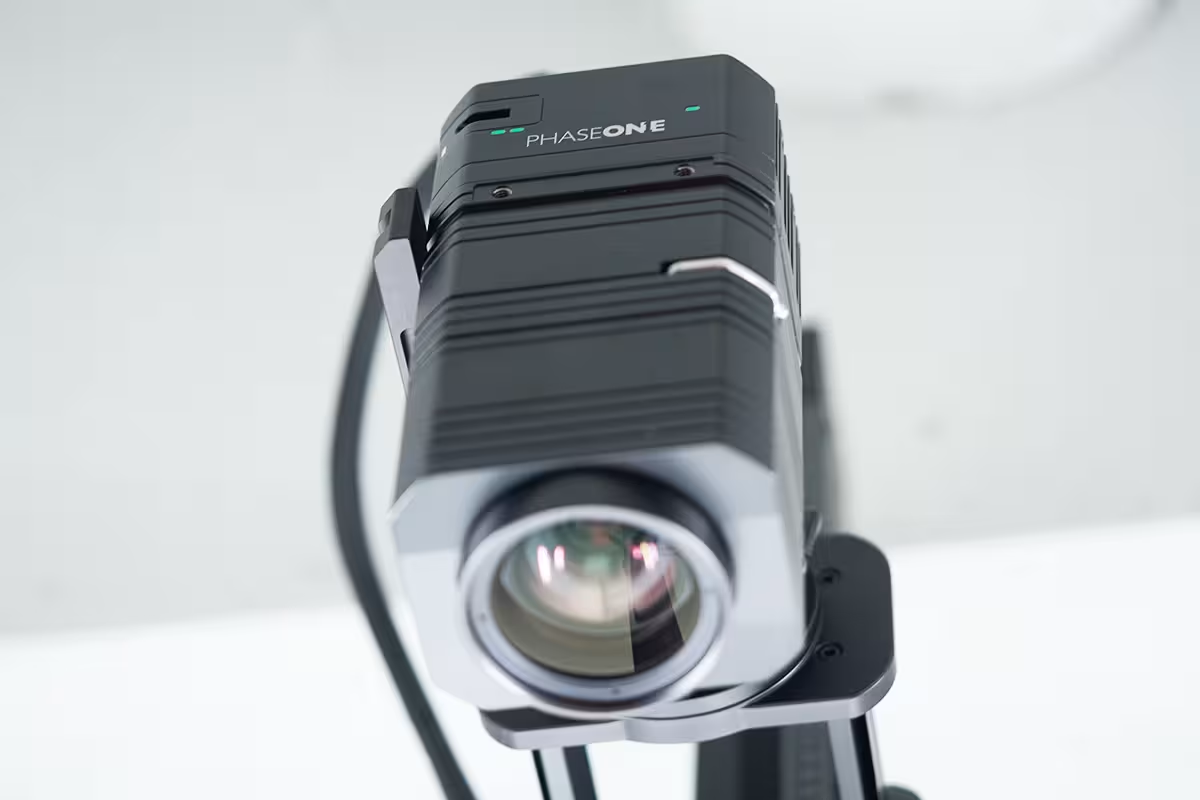
Since 2008, Shueisha has been working to digitally archive manga. Initially, we captured color originals using the EverSmart Supreme II, a high-precision scanner, and in 2015, we began using the Phase One IQ180, a high-resolution digital camera. Since 2020, we have been using Phase One’s Cultural Heritage series. This has allowed us to capture and preserve colors beyond the reproducible range of commercial printing, while also retaining the texture of the paper on which the illustrations were created.
Using this digitally archived data and imaging equipment, we retouch the artwork, restoring the original colors as they were when the illustrations were created. To produce the final print, color is carefully managed at each stage, from the original artwork to the captured data and printing.
For illustrations that were created digitally, we perform color management and printing in the wider-gamut Adobe RGB color space, instead of the sRGB space typically used in commercial printing, resulting in deeper and more vibrant colors.